
Views: 222 Author: Tina Publish Time: 2025-11-03 Origin: Site


Content Menu
● Understanding Frame Pool Ladders
● Pre-Installation Preparations
● Detailed Step-by-Step Installation Guide
>> Step 1. Organize Parts and Read Instructions
>> Step 2. Assemble Ladder Sections
>> Step 3. Position and Secure Ladder at Poolside
>> Step 4. Fill Ladder Legs or Holders
>> Step 5. Secure Ladder Platform to Pool
>> Step 6. Attach Safety Features
>> Step 7. Final Inspection and Testing
● Advanced Safety Tips and Routine Maintenance
● Troubleshooting and Expert Adjustments
● Frequently Asked Questions (FAQ)
>> 1. Can I install a frame pool ladder myself, or is professional help required?
>> 2. How do I size my ladder to fit my pool height?
>> 3. What's the best way to prevent pool liner damage?
>> 4. Why do pool ladders require filling with sand or water?
>> 5. How should I maintain my ladder during the off-season?
A pool is the centerpiece of family fun, exercise, and summer relaxation, but safety and convenience are paramount. A well-installed frame pool ladder ensures that everyone—from children to adults—can get in and out of the pool securely and comfortably. This article serves both as a technical installation manual and a buying guide, offering clear, actionable advice for OEM suppliers, contractors, and homeowners seeking reliable above-ground pool ladder solutions.[2][4]
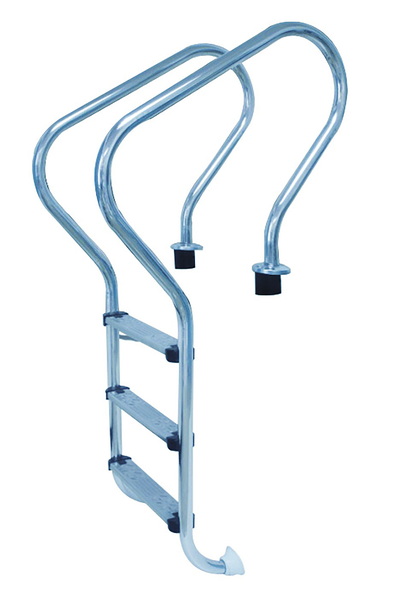
Frame pool ladders come in various designs to suit different pool heights, deck types, and safety needs:
- A-frame pool ladders: Popular for above-ground pools, with steps both inside and outside, plus swing-up safety treads.
- Deck-mounted ladders: Secured directly to a pool deck, often with flanges and special anchor bolts.
- Resin and steel models: Offer varying resistance to corrosion and strength profiles suitable for heavy, frequent use.[1][2]
Choosing the right ladder means considering pool height, user weight limit, safety features (anti-entrapment barriers, locking gates), and ease of assembly.
Gather these essential tools and supplies for installation:
- Ladder kit (check for all hardware, rails, treads, platforms)
- Rubber mallet
- Electric drill & screwdrivers
- Level
- Marker pen
- Wrenches, sockets, Allen key
- Drill bits: 5/16" or 1/8”, or as specified in the manual
- Ladder mat/pad for liner protection
- Fasteners: bolts, nuts, washers
- A friend/helper for safe lifting and alignment.[4][1][2]
Thorough prep minimizes installation errors and safety risks:
- Ensure the ground around the pool is flat, firm, and free of debris.
- Unpack all ladder components, laying them out for easy identification.
- Review the product manual for model-specific details.
- Inspect pool liner/walls for damage—never install against a compromised pool structure.
If the ladder features adjustable legs, prepare to size them according to the pool's height. Mark “cut lines” on the handrails for custom fit—a hacksaw is often needed for this step.[1]
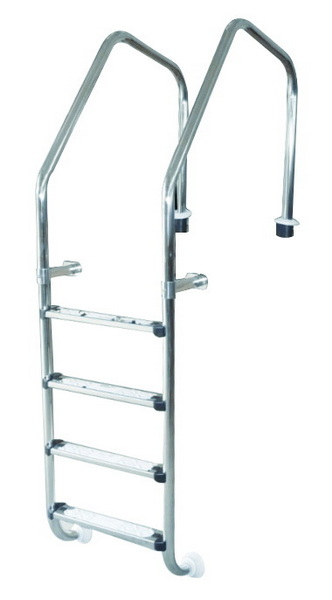
- Lay out all parts on a clean, level surface.
- Use the parts diagram in your manual to match fasteners, treads, rails, and platforms.[3][8][1]
- Check that all needed hardware is present.
- Attach treads (steps) to the side rails. Use a rubber mallet to tap each step in firmly.
- Insert handrails into platform channels; secure with bolts and nuts. Tighten with a wrench but do not overtighten—handrails should be rigid, not loose.
- Some models require additional anti-entrapment barriers or step caps.
- If ladder height must be customized, use a hacksaw to carefully trim the handrail at marked lines (for example: "52” cut" or "48” cut" per pool height).[1]
- For A-frame ladders, position one side inside the pool, one outside. Swing-up treads should face outwards for safety.
- Place a ladder mat under the feet for vinyl liner pools (crucial to prevent tears).[4][1]
- Adjust extension boots if needed for the perfect fit at variable pool heights. Rail boots can often be repositioned.
- Ladders may require filling inner tubes with water or sand for stability. For water, gently tip the ladder to let trapped air escape; fill until the ladder sits steadily and does not float.
- For sand, use a funnel to add roughly 20 lbs per holder compartment as advised by the manual.[5][2][1]
- Mark bolt hole locations on the deck or pool ledge using the platform as a guide.
- Drill holes with the specified drill bit, then attach using supplied bolts, nuts, washers.
- Carefully align platform so it sits level and firm atop the pool wall—this supports weight and prevents wobbling.
- For deck-mounted ladders, insert handrails into deck holes and use flanges plus screws to lock everything in place.[2][4][1]
- Install swing-up treads on the outside of the pool—these must be locked in the “up” position when not in use.
- Some models include roll-guards, locking gates, or child safety latches. Fit these accessories according to instructions to comply with safety regulations.[5][4]
- Confirm all bolts are tight and steps are level.
- Test ladder for stability: walk up and down, wiggle gently from side to side.
- Make final alignment adjustments as needed.
Ladder safety and care determine product lifespan and accident risk reduction:
- Check fasteners monthly—loose bolts can create hazards.
- Inspect for cracks, sharp edges (use sandpaper if necessary), or corrosion.
- Clean ladder surfaces regularly to prevent algae, grime, slipperiness.
- Always lock swing-up treads or roll-guards when pool is not supervised.
- Cover/removable ladders should be stored indoors during winter months.
- Never leave ladders accessible when pool is unattended—child supervision is mandatory at all times.[2][4][1]
Solving common pool ladder problems:
- Ladder not stable: Check for missing fills (sand/water). Make sure feet are on level base, and platform is tightly bolted.
- Wobble or movement: Retighten all connections, verify bolt alignment, reposition or adjust extension boots.
- Steps not level: Pool bottom may be uneven—adjust rail boots or use shims if needed.
- Damage to liner: Always use a step mat. If there is abrasion, reposition the ladder and inspect all contact points.
- Difficulty locking swing-up tread: Lubricate hinge points and check installation sequencing.
If unsure, consult the ladder's manufacturer or professional pool installer for help.[8][4][1][2]
Installing a frame pool ladder is a straightforward project when approached methodically. From organizing components to fine-tuning safety features, every step is crucial for reliable pool access and safety. Regular routine checks, proper maintenance, and diligent supervision are the keys to protecting your family, guests, and pool investment. For OEM suppliers, contractors, and international buyers, specifying ladders with clear installation instructions and compliance with global safety standards supports successful overseas partnerships and customer satisfaction.
For most ladders, homeowners can perform installation with basic tools and by following the instruction manual. However, professional help is advisable for large pools or custom ladder solutions.[1][2]
Many A-frame ladders include cut lines on handrails—use a hacksaw for precise adjustment. Always double-check your pool's height before cutting.[3][1]
Always place a ladder pad under the ladder feet; inspect sharp edges and sand them smooth before installation. Avoid dragging the ladder across the liner.[4][1]
Internal weight prevents ladders from floating or slipping. Fill as instructed, ensuring complete water entry or the specified amount of sand per manual.[2][1]
Disassemble and store removable ladders indoors. Inspect for rust or cracks, tighten bolts, and clean with mild soap before reinstallation or storage.[2]
[1](https://lumi-o.com/app/uploads/2023/03/71550-A-Frame-Blow-Molding-Ladder.pdf)
[2](https://www.poolkingfilter.com/how-to-install-pool-ladder-above-ground.html)
[3](https://www.propools.com/Manuals/63043_20211268342.pdf)
[4](https://www.pioneerfamilypools.ca/wp-content/uploads/resources/pools-info/2manuals/A-Frame%20Ladder%20Manual.pdf)
[5](https://www.royalswimmingpools.com/NE1162manual.pdf)
[6](https://www.youtube.com/watch?v=JJkG7vsan1E)
[7](https://images.thdstatic.com/catalog/pdfImages/db/db34ae25-8daa-451a-8c9f-f25c27c97b44.pdf)
[8](https://www.familypoolfun.com/pdf/ne1222_manual.pdf)
[9](https://www.intexsales.com/b2cmnl/B2CMNLServlet?instantiate=B2cMnldownloadApp&action=pub_mnl&filnam=330IO_A0_1805_EN.pdf)
[10](https://mrpoolman.com.au/blogs/news/easily-install-or-replace-your-pool-ladders-and-rails)
[11](https://www.youtube.com/watch?v=6D2VWj3Z_q8)
[12](https://www.shutterstock.com/search/pool-ladders)


