
Views: 222 Author: Tina Publish Time: 2026-01-12 Origin: Site


Content Menu
● How to Assemble an Above Ground Pool Ladder
● Tools, Parts and Safety Prep
● Step‑by‑Step Assembly Instructions
>> Step 1 – Unpack and Sort Components
>> Step 2 – Assemble the Inside Ladder Section
>> Step 3 – Assemble the Outside Ladder Section
>> Step 4 – Install the Top Platform and Handrails
>> Step 5 – Fill Weight Chambers or Add Sand (If Required)
>> Step 6 – Position the Ladder and Attach Brackets
>> Step 7 – Final Checks and Test Use
● Safety Tips for Above Ground Pool Ladders
● Maintenance and Troubleshooting
>> 1. Where is the best place to install my above ground pool ladder?
>> 2. How do I keep my ladder from floating or moving?
>> 3. Can I use any above ground ladder with my pool?
>> 4. How often should I inspect my pool ladder?
>> 5. What safety features should I look for in a new ladder?
>> 6. Is it necessary to remove the ladder when the pool is not in use?
How to assemble an above ground pool ladder correctly starts with sorting all parts, following the manufacturer's manual step by step, and double‑checking stability and safety before anyone uses the pool. Choosing the right location, anchoring the ladder, and teaching basic safety rules are just as important as the assembly itself.[1][2][3]
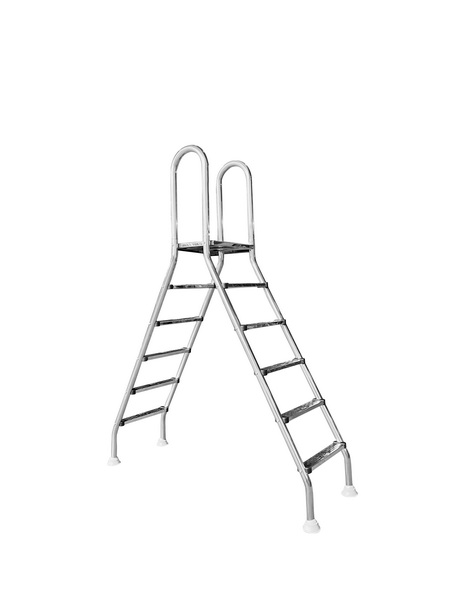
Above ground pool ladders come in different designs, but most share common components and assembly logic. This guide walks through universal steps you can adapt to your specific model while highlighting key safety tips and visual resources.[2][1]
Before opening the hardware bags, make sure the work area is flat, dry, and close to the pool.
- Typical tools: Phillips screwdriver, adjustable wrench, rubber mallet, tape measure, and sometimes a drill for deck anchors.[4][1]
- Common parts: inside and outside ladder rails, treads/steps, top platform, braces, mounting brackets, bolts, nuts, and caps.[5][3]
- Safety prep: wear non‑slip shoes, keep kids away during assembly, and read the full ladder manual once before starting.[6][5]
Every manufacturer has slightly different hardware and hole layouts, but the core process is similar.[3][1]
- Lay all rails, treads, platform pieces, braces, and hardware out on a tarp or carton to avoid scratching.[5]
- Match part numbers or letter labels (A, B, +, −) on the rails and treads to the diagram in the manual.[9][5]
The “inside” side usually faces the pool interior and may include weight pockets or sand fill openings.
- Place the two inside rails parallel on the ground, oriented according to the up/down markings.[9][3]
- Insert the treads into the matching openings (for some models, “+” ends go into “+” holes and “−” ends into “−” holes) and tap them fully home with a rubber mallet until seated on the internal lugs.[9][5]
The outside section faces away from the pool and may have flip‑up or lockable features for safety.
- Position the two outside rails on a flat surface and repeat the tread insertion process, following the orientation labels carefully.[3][9]
- Leave any “flip‑up” or removable bottom tread for later if the manual instructs you to install it after positioning the ladder.[6][3]
The platform ties both sides together and supports the user during entry and exit.
- Align the platform over the tops of the inside and outside rails and push or bolt it into place according to your model's instructions.[3][5]
- Attach handrails to the platform and rails with the supplied bolts, washers, and locknuts, tightening securely while keeping rails parallel.[4][5]
Many resin or plastic ladders require added weight to prevent floating.
- Move the assembled inside portion into the pool, tilting it to let water fill any hollow steps while air escapes.[4]
- Using a funnel, pour the recommended amount of sand (often around 40 lb total, split between sides) into the designated fill ports, then close the caps firmly.[4][3]
Location and attachment are critical for long‑term stability and safety.
- Choose a position where the ladder is clearly visible from the house or seating area and away from structural support posts on the wall.[10][1]
- For deck‑mount ladders, install deck flanges or anchor brackets, drill needed holes, and bolt the handrails or mounting tubes to the deck according to the layout.[1][4]
- For A‑frame ladders, level the ground under the outer feet and ensure the base sits solidly without rocking before securing any braces to the pool frame if required.[1][3]
Before anyone swims, perform a careful inspection.
- Verify all nuts, bolts, and step connections are tight, with no sharp edges, burrs, or protruding hardware exposed.[2][10]
- Have an adult slowly climb up and down while another person checks for wobble, flex, or movement at the feet or brackets; tighten or shim as needed.[10][1]
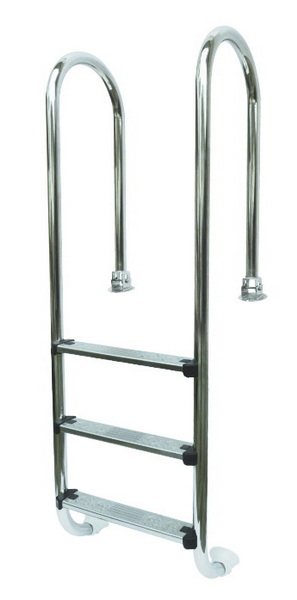
Good assembly is only part of safe pool access; daily use and supervision matter just as much.
- Choose ladders with non‑slip treads, dual handrails, and step widths of at least about 3 inches to give users confident footing.[11][2]
- Keep the ladder clear of toys, floats, and heavy objects that could damage steps or cause tripping.[10]
- Do not allow multiple people on the ladder at once, and always supervise children when they climb in or out of the pool.[2][10]
- When the pool is not in use, lock any integrated roll‑guard or flip the outside section up, or remove the ladder if your model allows, to prevent unsupervised access.[2][6]
Regular inspection keeps your ladder safe and extends its service life.
- Rinse metal parts with fresh water, especially in saltwater or heavily chlorinated pools, and inspect for rust, cracks, or UV damage at least once a month.[12]
- Tighten hardware periodically, replace worn tread caps or grips, and follow the manual's weight‑limit and chemical‑exposure recommendations.[12][6]
- In winter or long idle periods, remove the ladder from the pool if possible, drain internal water, and store it in a shaded, dry place to reduce fading and brittleness.[12]
Even a well‑maintained ladder will eventually need replacement.
- Replace the ladder if you see structural cracks, loose rails that will not stay tight, severe rust, or warped steps that feel unstable.[11][12]
- Consider upgrading to a model with integrated barriers, lockable roll‑guards, or higher weight capacity when your household's needs change.[11][2]
Assembling an above ground pool ladder is straightforward when you organize the parts, follow the manufacturer's sequence, and verify every connection before use. By adding proper anchoring, regular maintenance, and strong safety habits—such as locking or removing the ladder when the pool is unattended—you create a safer, more comfortable entry and exit experience for every swimmer.[10][2][3][1]
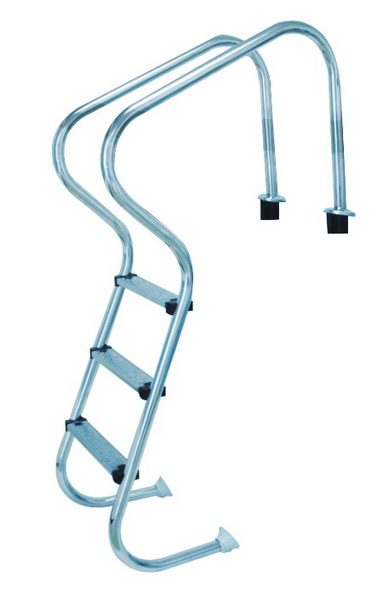
The best location is a visible, easily supervised spot that is free from structural supports or obstructions on the pool wall. Avoid tight corners so users have room to turn, step down, and move away from the ladder safely.[10][1]
Fill all designated weight chambers with sand or the manufacturer‑approved ballast and make sure water has displaced trapped air inside the steps. Then verify the feet sit flat on the ground or deck and tighten any braces or anchor hardware fully.[3][1][4]
Not every ladder fits every pool; you must match ladder height, wall type, and weight rating to your specific pool and user group. Always check the manufacturer's compatibility chart and safety standards before buying or installing a ladder.[12][11][1]
A quick visual check before each swim session plus a more thorough monthly inspection is recommended. Look for loose bolts, cracked steps, sharp edges, or corrosion, and repair or replace parts as needed.[10][12]
Look for non‑slip treads, two secure handrails, robust anchoring hardware, and safety barriers or roll‑guards that prevent unsupervised access. For homes with children, a lockable or removable outside section is strongly recommended.[6][2][11]
Many safety guidelines recommend making ladders inaccessible when the pool is unattended—either by removing the ladder, flipping up the outside section, or locking an integrated guard. This reduces the risk of unauthorized or unsupervised entry, especially by children.[2][6]
[1](https://blog.watsons.com/blog/install-above-ground-pool-ladder)
[2](https://www.poolfencediy.com/blogs/blog/pool-ladder-safety)
[3](https://www.familypoolfun.com/pdf/ne1222_manual.pdf)
[4](https://poolpartstogo.com/blogs/pool-equipment/how-to-fit-a-ladder-to-your-above-ground-pool-the-right-way)
[5](https://www.royalswimmingpools.com/NE1201manual.pdf)
[6](https://www.intexsales.com/b2cmnl/B2CMNLServlet?instantiate=B2cMnldownloadApp&action=pub_mnl&filnam=330IO_A0_1805_EN.pdf)
[7](https://www.youtube.com/watch?v=JJkG7vsan1E)
[8](https://www.youtube.com/watch?v=AcVIHFSLCTY)
[9](https://www.youtube.com/watch?v=qb_u48dTL0M)
[10](https://sternsbackyard.com.au/blogs/news/safety-tips-for-installing-and-using-above-ground-pool-ladders)
[11](https://poolfence.com/pool-ladders-a-step-toward-safety/)
[12](https://www.svadonpoolcn.com/slug-a-comprehensive-guide-to-in-ground-pool-ladders-safety-selection-and-maintenance/)
[13](https://www.youtube.com/watch?v=UOszx5_q0s4)
[14](https://www.facebook.com/groups/637529959937311/posts/2656993104657643/)
[15](https://www.youtube.com/watch?v=qpJDdgZaclQ)


