
Views: 222 Author: Tina Publish Time: 2026-01-08 Origin: Site


Content Menu
● Step 1: Remove Trapped Air from the Ladder
● Step 2: Use Built‑In Sand or Water Chambers
● Step 3: Add External Pool Ladder Weights
● Step 4: Protect Vinyl Liners While Adding Weight
● Step 5: Anchor the Ladder to the Deck or Pool Frame
● Step 6: Choose the Right Ladder Type and Height
● Step 7: Maintenance Tips to Prevent Future Floating
● When to Consider a New Ladder or Step System
● How Pool Filtration and Circulation Affect Ladder Stability
● FAQs About Floating Pool Ladders
>> 1. Can I just use sandbags or bricks to weigh down my pool ladder?
>> 2. Is it safe to drill extra holes in my pool ladder to let air out?
>> 3. How much sand do I need to keep my pool ladder from floating?
>> 4. Will extra ladder weight damage my vinyl liner?
>> 5. My ladder still floats even after filling the chambers—what now?
>> 6. Do built‑in stairs ever float like removable ladders?
A pool ladder usually floats because air is trapped inside the hollow steps or there is not enough internal weight, so the solution is to remove as much air as possible and then add safe ballast (water, sand, or dedicated weights) while keeping the ladder securely anchored and protecting your pool surface. With the right combination of vent holes, internal fill chambers, and external weights, your ladder will sit firmly on the pool floor and feel solid when anyone climbs it.[1][2][3]
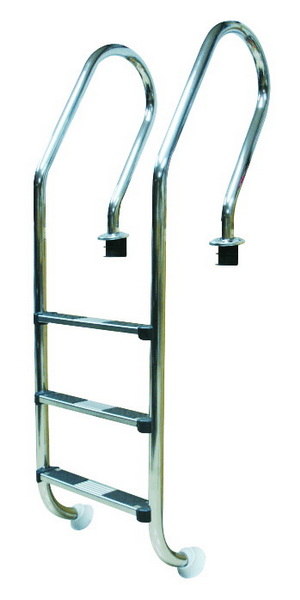
Most modern pool ladders and drop‑in steps are made from hollow plastic or resin, which naturally traps air and makes the structure buoyant in water. When there is not enough ballast inside the ladder body, the entire unit tries to float up, especially near the shallow end.[2][1]
- Trapped air pockets inside hollow treads and side panels reduce the effective weight of the ladder, making it lift off the floor.[4][1]
- Lightweight designs help shipping and assembly but require additional ballast (water, sand, or weights) once the ladder is in the pool.[1][2]
- In vinyl‑liner pools, many owners avoid adding weight because they are afraid of damaging the liner, which can allow ladders to float or drift.[3][2]
Before adding weight, always remove as much trapped air as possible, because a fully water‑filled ladder is already significantly heavier and more stable. This step alone solves many floating problems with newer resin steps that are designed to flood with water.[4][1]
- Take the ladder or steps out of the pool, tilt them on their side, then slowly submerge them again while rocking back and forth so bubbles escape through the existing vent holes.[4]
- For products that allow drilling, some pool owners add a few extra small vent holes low on the sides to help air escape and water enter, following the manufacturer's safety guidance.[5][6]
- Use a helper to hold the ladder at different angles under the water until bubbles completely stop coming out; this indicates the internal chambers are fully flooded.[1][4]
Many premium above‑ground and in‑pool ladders include built‑in cavities or chambers that are specifically designed to be filled with sand or water to act as ballast. Filling these correctly is the cleanest and safest way to keep the product from floating.[3][1]
- Follow the instruction manual to locate fill holes and verify how much sand or water each side panel or step chamber should hold; some models call for 70 lb or more of sand total.[1]
- Use #20 silica sand or clean, dry play sand poured through a funnel, shaking the panel as you work so the sand settles and completely fills the lower sections for maximum weight.[2][1]
- On certain ladders, manufacturers explicitly allow coarse sand or gravel inside the hollow frame for extra ballast, while still meeting safety and stability standards.[3]
If your ladder supports water ballast, full chambers plus air removal may be enough to keep it down without external weights, especially in smaller above‑ground pools.[2]
If the ladder still wants to float after venting air and filling internal chambers, the next option is external weights placed around the base, designed for underwater use. Purpose‑made ladder weight bags are safer than improvised bricks or metal.[7][2]
- Commercial step‑weight bags can be filled with sand and then sealed, giving you a heavy but smooth package that can be hung from or set beside the ladder base.[7][2]
- Some owners make DIY PVC weights by filling capped PVC tubes with sand or concrete and fastening them to the ladder with plastic zip ties or stainless hardware.[8][9][10]
- Place all weights so they do not press sharp edges into a vinyl liner; use smooth surfaces and keep them slightly away from the wall when possible.[2][3]
When dealing with vinyl‑liner pools, keeping the ladder from floating must always be balanced with protecting the liner from punctures, pressure points, and abrasion. The correct base design and protective mats make a big difference.[3][2]
- Choose ladders or steps with wide, smoothly rounded bases designed for vinyl surfaces; some models even include built‑in pads or specify optional protective mats.[11][3]
- Use a dedicated ladder or step mat made from heavy, non‑slip rubber under the base to distribute the load and prevent the ladder or weights from rubbing the liner.[2][3]
- Keep the back of the step about 1 inch away from the pool wall so the structure does not rest directly on the liner while still leaving enough space for water circulation.[1][3]
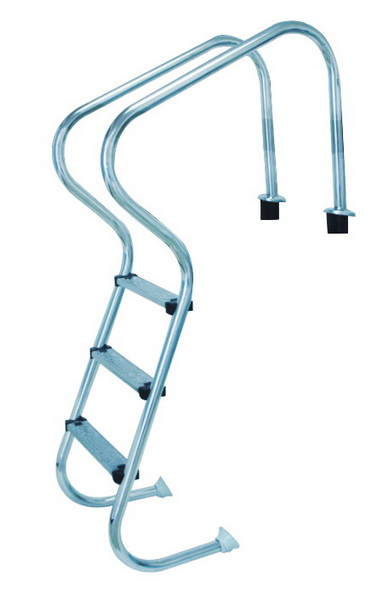
Even a well‑weighted ladder can shift or tilt if it is not firmly anchored to a deck or top rail, which makes it feel unstable to swimmers. Proper anchors stop both floating and wobbling in everyday use.[3][1]
- Many in‑pool ladders include front and rear mounting flanges that bolt directly to the deck, locking the handrails and top treads in place.[3]
- When installing, position the ladder roughly 1 inch from the liner, then extend the connectors onto the deck and fix them with the correct stainless fasteners to avoid rust.[1][3]
- For soft‑sided or metal‑frame above‑ground pools without a full deck, use compatible brackets or clamp‑on supports recommended by the ladder manufacturer.[12][3]
Sometimes the real reason a ladder will not stay down is that it is the wrong style or height for the pool, which limits contact with the floor and makes proper weighting difficult. Matching ladder type to pool configuration dramatically improves stability.[13][3]
- In‑pool ladders designed for decks typically specify a wall height range (for example, 48–60 inches) and must be used only within that range for safe installation.[13][3]
- Soft‑sided and freestanding pools often require special A‑frame ladders or hybrid systems that rest correctly on both the deck/top rail and the pool floor.[12][13]
- Integrated steps—such as molded or vinyl‑over stairs in in‑ground pools—are permanently attached to the structure and almost never float when installed correctly.[11]
Even a well‑installed ladder can start to float again if sand escapes, water drains out of chambers, or hardware corrodes and loosens over time. A simple seasonal checklist helps keep everything under control.[2][1]
- At the start of each season, confirm that internal chambers are still full, refill sand or water if needed, and inspect DIY weights for cracks or leaks.[8][2]
- Check all deck anchors, flanges, bolts, and handrails for movement or rust, tightening or replacing hardware as needed for rigid support.[3]
- When winterizing, some owners remove heavy sand from step chambers with a wet/dry vacuum to make the ladder easier to lift, then re‑fill the following season.[1][2]
If your current ladder repeatedly floats, even after proper weighting, it may be time to upgrade to a more stable design or a complete entry system, especially for families and commercial pools.[11][3]
- Look for ladders and steps from reputable manufacturers that explicitly state they meet or exceed APSP/ANSI standards for above‑ground/on‑ground pool ladders.[3]
- Integrated step systems with internal ballast options, wide bases, and strong mounting hardware provide a more professional, long‑term solution than improvised weights.[13][1]
- For in‑ground pools, vinyl‑over or molded steps designed into the pool structure give a stable, aesthetic entry that never needs external sandbags.[11]
While the main cause of floating ladders is lack of ballast, water movement from the circulation and filtration system can also nudge a light ladder around the pool. Proper circulation design and flow control valves reduce this effect.[2][3]
- Strong return jets pointed directly at light steps can gradually push them away from the wall if they are not firmly anchored or correctly weighted.[2]
- Using appropriately sized sand, DE, or cartridge filters and pumps helps maintain balanced flow without unnecessary turbulence around the ladder.[11][3]
- When upgrading equipment, consider complete OEM systems where the ladder, steps, filter tank, and pump are designed to work together for both safety and comfort.[11][3]
Keeping a pool ladder from floating is a mix of physics and good hardware: remove trapped air, add the right ballast in the right place, protect the liner, and anchor the structure securely. With properly filled sand or water chambers, optional external weights, and solid mounting to the deck or frame, your ladder will stay down, feel stable, and make entering and exiting the pool comfortable for everyone.[1][2]
Loose bricks or rough concrete blocks are not recommended because they can shift, scratch, or puncture a vinyl liner and create entrapment hazards. Purpose‑made sand weight bags or smooth, capped PVC weights are much safer options for long‑term use.[8][2][3]
Some pool owners drill additional small holes in plastic steps to release trapped air, but this should only be done if the manufacturer's instructions allow modifications in those areas. Holes must be smooth, free of sharp edges, and located so they do not weaken structural parts or create new entrapment points.[6][5][1][3]
The required amount varies by model, but many above‑ground steps call for dozens of pounds of sand—one popular system uses around 70 lb split between internal side‑panel chambers. Always check the manual for the exact weight and filling locations to avoid under‑ or over‑loading the structure.[1][2]
Extra weight is safe when it is spread over a wide, smooth base and supported by a protective ladder mat, rather than concentrated on sharp edges or small contact points. Choose ladders specifically rated for vinyl‑liner pools and follow the recommended gap between the rear of the step and the wall to protect the surface.[2][3]
If the ladder still rises, check that all chambers are truly full, remove any remaining trapped air, and consider adding external ballast like sealed sand weight bags around the base. If the product remains unstable, it may be undersized or incompatible with your pool design and should be replaced with a ladder or step system designed for your wall height and pool type.[13][3][1][2]
Built‑in molded or vinyl‑over steps are anchored to the pool shell and usually backfilled or reinforced, so they are designed not to float when installed correctly. If those steps move or shift, it often indicates a structural or installation problem that requires professional inspection.[11]
[1](https://www.thepoolfactory.com/blogs/equipment/how-prevent-pool-steps-from-floating)
[2](https://www.homesandgardens.com/gardens/how-to-weigh-down-pool-steps)
[3](https://www.doheny.com/help/for-ladder-specs)
[4](https://www.youtube.com/watch?v=pacoHDlvEAE)
[5](https://www.youtube.com/watch?v=-qkS06U4SC0)
[6](https://www.facebook.com/groups/637529959937311/posts/2536582576698697/)
[7](https://adelaideepic.org/Step-Weights-Sand-Fillable-Bags-For-Above-Ground-Pool-Ladder-1309392)
[8](https://www.poolspaforum.com/forum/index.php?%2Ftopic%2F1059-weighing-pool-steps-downalternative-for-sand%2F)
[9](https://www.reddit.com/r/pools/comments/v0lhxh/what_sand_weights_do_you_use_to_hold_down_your/)
[10](https://www.reddit.com/r/swimmingpools/comments/13rsugx/floating_stairs_what_do_you_use/)
[11](https://www.lathampool.com/vinyl-liner-pool-steps/)
[12](https://www.perplexity.ai/search/471b2f9d-5e3c-4c30-939f-e62d323a196d)
[13](https://www.thepoolfactory.com/products/soft-touch-above-ground-pool-steps)
[14](https://www.reddit.com/r/pools/comments/wubcro/how_to_keep_stairs_down_on_floor_instead_of/)
[15](https://www.facebook.com/groups/637529959937311/posts/2597477427275878/)
[16](https://www.facebook.com/groups/637529959937311/posts/2594449264245361/)


