


Content Menu
● Understanding Your Pool Ladder Lock
● Safety Precautions Before Unlocking
● How to Unlock an A‑Frame Flip‑Up Ladder
● How to Unlock a Roll‑Guard Safety Ladder
● How to Unlock an In‑Pool Ladder with Snap‑Lock Pins
● Unlocking Deck‑Mounted Inground Ladders (Anchor Wedges)
● Dealing With a Stuck or Corroded Ladder Lock
● How to Relock the Ladder After Use
● Recommended Pool Ladder Safety Upgrades
● Visual Guide: Typical Lock Positions
>> 1. Why won't my inground pool ladder come out even after I loosen the bolts?
>> 2. Is it safe to leave my above‑ground pool ladder unlocked when I am at home?
>> 3. Can I retrofit a lock onto an older pool ladder?
>> 4. How often should I service my ladder locks and anchors?
>> 5. What are the most important safety features to look for in a new pool ladder?
>> 6. Should I remove my ladder completely for winter?
Unlocking a pool ladder sounds simple, but the exact steps depend on the lock style, ladder type, and how long the hardware has been in place. This guide walks through the main scenarios so homeowners, service pros, and brand owners can handle customer questions with confidence.[1][2][3]
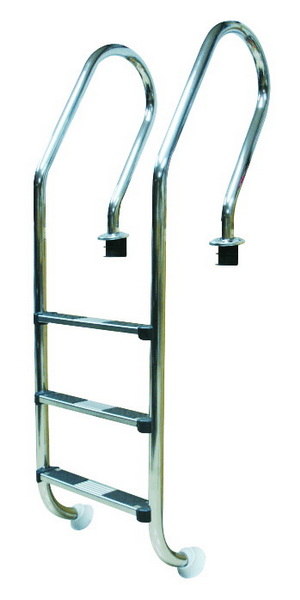
Different pool ladders use different locking systems, and identifying yours is the first step before trying to unlock anything. Common options include flip‑up or slide‑up outside treads, roll‑guard gates, snap‑lock pins, and deck‑mounted anchor bolts.[4][3][1]
- Above‑ground A‑frame ladders often use flip‑up or slide‑up outside steps that are locked with a padlock or cam mechanism so kids cannot climb from the yard.[1][4]
- Premium A‑frame designs may feature a roll‑down “garage door” style guard that blocks all outside treads and locks in place with a padlock.[5][4]
Inground ladders usually slide into metal anchor cups in the deck and are held by a wedge assembly tightened with top bolts. Some also add snap‑lock pins or external brackets at deck level to satisfy local safety codes.[2][6][1]
Pool ladder locks are part of a safety system, so unlocking them always needs a quick risk check. Before you start, confirm that children and unsupervised guests are kept away and that there is active adult supervision while the ladder is usable.[6][4][1]
- Check the water clarity, water level, and circulation to ensure the pool is safe to enter after unlocking the ladder.[4][6]
- Wear non‑slip footwear and work from a dry, stable deck or ground surface to avoid slips while handling tools or heavy ladder rails.[7][2]
If you expect to loosen bolts or use a mallet, keep metal tools away from live electrical equipment such as pool lights and pumps. For commercial or rental pools, always follow the site's written safety protocol and any local regulations on locking or securing access.[2][6][1][4]
Flip‑up A‑frame ladders are common on above‑ground pools and typically rely on a padlock or built‑in cam to keep the outside section raised. Unlocking them is usually fast if the hardware is not rusted.[3][1]
Steps to unlock a flip‑up A‑frame ladder:
1. Stand outside the pool facing the ladder and locate the padlock or cam latch that holds the outside steps in the raised position.[1][4]
2. Use the correct key or combination to open the padlock, or rotate the cam handle to its unlocked symbol or position as shown in the ladder's manual.[8][1]
3. Once the lock is removed, support the weight of the outside section with one hand and slowly lower the steps until they are fully seated on the ground.[7][1]
4. Check that every tread is stable and that any safety latches are fully engaged in the “use” position before allowing swimmers to climb.[6][1]
Roll‑guard A‑frame ladders integrate a roll‑down panel that covers the outside steps when not in use. The panel usually has a built‑in locking tab or hole for a padlock at the top.[5][4]
To unlock a roll‑guard style ladder:
1. Stand outside the pool and confirm the roll‑guard panel is in the down (closed) position; locate the padlock or locking tab hole near the top bridge.[5][4]
2. Remove the padlock, then pull the locking tab out or away from the bridge to release the guard mechanism as indicated in the manufacturer's instructions.[5]
3. Grasp the top edge of the roll‑guard and lift it upward, sliding it along its tracks until it passes over the top of the ladder and rolls toward the inside of the pool.[4][5]
4. Push the locking tab back into the “in‑use” position on the inside so the guard cannot accidentally roll back down on a user's legs.[5]
Some premium above‑ground and inground ladders use snap‑lock pins through the treads or handrails to secure a removable or slide‑up section. These pins often have a spring‑loaded button or collar.[2][1]
To unlock snap‑lock style ladder sections:
1. Identify the snap‑lock pins at each side of the secured tread or rail; they usually sit in through‑holes in the ladder tube with a head or ring on the outside.[3][1]
2. Depress the spring button or pull back the locking collar while gently pulling the pin straight out of the tube.[1][2]
3. Repeat for any additional pins securing the same ladder section, keeping a hand on the ladder to prevent sudden movement when the last pin is removed.[2][1]
4. Once all pins are out, lower or slide the ladder segment into its usable position, then reinsert the pins in the designated “use” holes if the design requires it.[3][1]
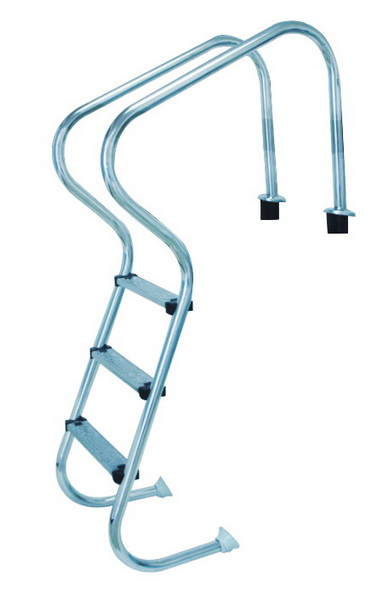
Standard inground ladders slide into anchor cups set in the pool deck and are locked by internal wedges tightened by top bolts. Unlocking usually means releasing the wedge so the rails can move freely.[2]
To release the anchor wedge and unlock the ladder:
1. Use a suitable socket (often 0.5 inch) with a ratchet to loosen each anchor bolt several turns until the bolt head sits slightly above deck level.[2]
2. With a rubber mallet or the end of the socket, tap straight down on the loosened bolt to push the internal wedge down and away from the ladder rail.[9][2]
3. After both wedges are released, grip the ladder rails firmly and test for movement by gently rocking front to back and side to side.[2]
4. When you feel some play, lift straight up on both rails at once to unlock the ladder fully and free it from the cups if you plan to remove it for service or winterizing.[7][2]
Older ladders or those exposed to saltwater or aggressive water chemistry may seize, making unlocking difficult even when bolts are fully loose. Patience and the right tools protect both the deck and the stainless steel.[11][2]
For stuck anchor wedges or rails:
- Apply a small amount of suitable penetrating oil around the anchor bolt area or between the rail and anchor cup, carefully preventing it from running into the pool water.[12][2]
- Wait several hours, then try loosening and tapping the bolts again, followed by a controlled upward lift or light upward taps under the rail with a rubber mallet over a wood block.[11][2]
If the ladder is severely corroded or the anchor hardware is damaged, replacement may be safer than forcing it. Some pool professionals recommend cutting off a hopelessly stuck ladder flush with the deck and replacing anchors, especially when safety and aesthetics are priorities.[9][2]
Relocking the ladder after swimming is just as important as unlocking it, particularly for households with children. The exact process is the reverse of unlocking but must always end in a verified locked state.[1][4]
Key relocking steps:
- For flip‑up or slide‑up A‑frames, lift the outside steps, engage the manufacturer's latch, and secure a weather‑resistant padlock through the designated holes.[4][1]
- For roll‑guard ladders, roll the guard back down over outside treads, push the locking tab into place, and reinstall the padlock so the panel cannot be raised from outside.[4][5]
For inground ladders, slide the rails fully into the anchors, pull up slightly to seat them, and then tighten anchor bolts until the ladder does not lift or rock. Avoid overtightening, which can deform wedges or cups, making future unlocking more difficult.[11][2]
Many modern safety ladders and accessories make unlocking and relocking easier while significantly improving access control. Businesses selling complete pool packages can use these upgrades as added‑value features for families.[6][1]
Useful upgrades include:
- A‑frame safety ladders with integrated roll‑guards, flip‑up outer sections, and built‑in padlock points tested to current safety standards.[6][4]
- Enclosure systems with self‑closing, self‑latching gates that surround step units and automatically secure the entrance when not in use.[6][4]
Adding non‑slip treads, sturdy handrails, and entrapment‑barrier panels further reduces fall and entrapment risks around the ladder area. For tech‑minded owners, sensor‑based alarms can trigger alerts if the ladder or gate is opened unexpectedly.[3][1][6][4]
The table below outlines where locks are usually found and what motion “unlocks” each type.
| Ladder type | Typical lock position | Unlocking motion summary |
|---|---|---|
| Flip‑up A‑frame above‑ground | Padlock or cam at top outer steps brackets poolkingfilter | Remove padlock, release cam, then lower outer steps poolkingfilter+1 |
| Roll‑guard A‑frame | Locking tab and padlock at top bridge royalswimmingpools | Remove padlock, pull tab, roll guard to pool side royalswimmingpools+1 |
| Snap‑lock in‑pool or step unit | Pins through treads or rails near deck poolkingfilter | Depress button, pull pins, move ladder section poolkingfilter+1 |
| Inground ladder with anchors | Anchor bolts at deck surface over cups poolkingfilter | Loosen bolts, tap down to drop wedge, lift rails poolkingfilter |
| Enclosure gate system | Latch and sometimes padlock on gate frame thepoolfactory+1 | Lift or press latch, open gate; remove padlock if present thepoolfactory |
Unlocking a pool ladder correctly depends on recognizing the ladder design and lock type, from simple flip‑up A‑frames to anchored inground rails and snap‑lock step systems. With the right sequence—identify, unlock, test for stability, and then relock after use—pool owners can balance convenient access with reliable safety for children, pets, and guests.[1][4][2]
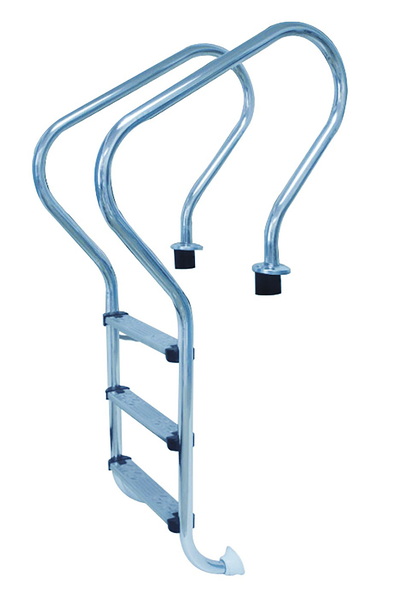
Most inground ladders are held by an internal wedge in the anchor cup; loosening the bolt alone is not enough because the wedge still grips the rail until the bolt is tapped downward. Mineral scale or rust can also bond the rail to the anchor, in which case penetrating oil and gentle rocking are usually required before the ladder unlocks and lifts free.[12][2]
Many safety guidelines recommend locking or removing ladders any time the pool is unsupervised, regardless of whether adults are home, because children can slip outside unnoticed. The safest practice is to unlock only when a competent adult is actively supervising swimmers and to relock or remove the ladder immediately afterward.[1][4][6]
In many cases, universal locking brackets, flip‑up conversion kits, or external padlock‑style restraints can be added to existing ladders. Always confirm compatibility with the ladder manufacturer and use corrosion‑resistant hardware designed for pool environments.[15][14][1]
At least once per swimming season, remove the ladder if possible, clean rails and anchor cups, and inspect all locking parts for corrosion or wear. In saltwater or heavily used commercial pools, more frequent checks help prevent seized wedges and stuck locks that make unlocking or removal difficult.[11][2]
Non‑slip treads, sturdy handrails, and a reliable, child‑resistant locking mechanism or enclosure are considered essential features. For above‑ground pools, roll‑guard barriers or flip‑up outer sections with padlock points are especially effective at preventing unsupervised access.[3][4][6]
In colder climates, many professionals recommend removing ladders before freezing weather to avoid damage from ice, snow load, and corrosion. Winter removal also forces at least one annual inspection of rails, locks, and anchors, making it easier to spot problems early.[7][2]
[1](https://www.poolkingfilter.com/how-to-lock-pool-ladder.html)
[2](https://www.poolkingfilter.com/how-to-remove-a-stuck-inground-pool-ladder.html)
[3](https://www.mavaquadoc.com/blogs/pool-maintenance-blog/different-types-of-pool-ladders)
[4](https://www.thepoolfactory.com/blogs/equipment/make-your-pool-safer-simple-steps)
[5](https://www.royalswimmingpools.com/NE1162manual.pdf)
[6](https://www.thepoolfactory.com/a/answers/5769020/What-are-the-essential-safety-features-for-pool-ladders)
[7](https://blog.watsons.com/blog/remove-above-ground-pool-ladder)
[8](https://www.propools.com/Manuals/63043_20211268342.pdf)
[9](https://www.poolspaforum.com/forum/index.php?%2Ftopic%2F13349-closing-the-pool-cant-get-the-ladder-out%2F)
[10](https://www.youtube.com/watch?v=4JtT3B246oA)
[11](https://www.youtube.com/watch?v=jHL7mH-UdwA)
[12](https://www.reddit.com/r/pools/comments/1p5vbob/sawing_off_stuck_pool_ladder/)
[13](https://www.youtube.com/watch?v=O09H6tW9WAk)
[14](https://vacbagz.com/blogs/news/dive-into-safety-choosing-the-perfect-pool-ladder)
[15](https://www.poolsupplies.com/shop/ladders-accessories)
[16](https://www.facebook.com/groups/637529959937311/posts/2370305403326416/)
[17](https://www.facebook.com/groups/637529959937311/posts/2292711147752509/)
[18](https://www.facebook.com/groups/637529959937311/posts/2228512837505674/)


