
Views: 222 Author: Tina Publish Time: 2025-12-08 Origin: Site


Content Menu
● How to Secure an Above Ground Pool Ladder
● Choose the Right Ladder Design
>> Common Above Ground Ladder Types
● Follow Manufacturer Instructions Carefully
● Anchor and Stabilize the Ladder
>> Anchoring Deck-Mounted Ladders
>> Stabilizing A‑Frame Ladders
● Add Weights and Ballast (When Approved)
>> External Weights and Anti-Float Methods
● Improve User Safety Features
>> Non-Slip Surfaces and Handrails
>> Keep Ladders Inaccessible When Not in Use
● Ongoing Inspection and Maintenance
>> Regular Checks and Adjustments
● FAQs About Securing an Above Ground Pool Ladder
>> FAQ 1 – How do I know if my above ground pool ladder is secure enough?
>> FAQ 2 – Can I put bricks or blocks under the ladder legs?
>> FAQ 3 – How can I stop my pool steps from floating?
>> FAQ 4 – Do I really need to remove or lock the ladder when the pool is not in use?
>> FAQ 5 – How often should I inspect and maintain my ladder?
How to secure an above ground pool ladder safely comes down to three things: choosing the right ladder, installing it on a truly level base, and adding mechanical anchors plus safety accessories such as mats, weights, and locks. Done correctly, this prevents tipping, reduces wear on your liner, and keeps children and older swimmers much safer.[1][2][3][4]
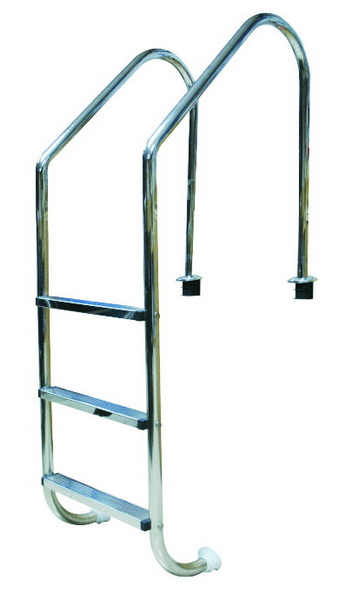
Above ground pools are only as safe as their access point, so a loose or wobbly ladder is a serious hazard, not just an irritation. A secure ladder protects users, extends equipment life, and helps you comply with many local safety and insurance expectations.[2][4]
A poorly secured above ground pool ladder can rock, slide, or even detach when someone climbs, especially lightweight plastic models or ladders on soft soil. This instability increases the risk of falls, pulled liners, and structural damage to the pool wall.[3][4][2]
In households with children, elderly swimmers, or pets, an unsecured ladder also becomes an easy route for unsupervised access, which is a key drowning risk factor. Lockable or removable ladders and proper barriers are now standard recommendations in modern pool safety guidelines.[5][1]
Not all above ground pool ladders secure in the same way, so start by understanding your ladder type. The right choice depends on whether you have a deck, your pool wall height, and the typical user weight and mobility.[6][7]
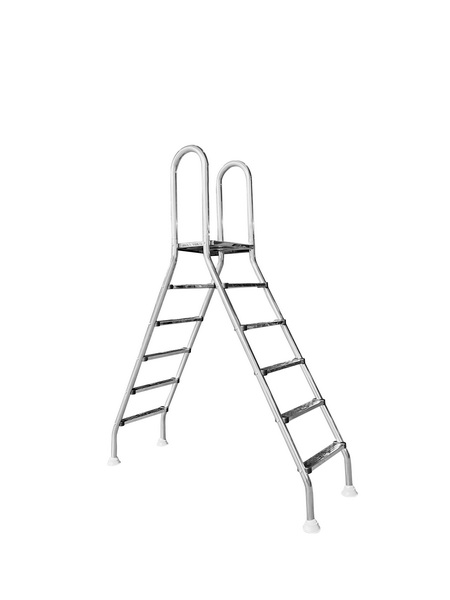
- A‑frame ladders span both inside and outside of the pool, resting on the ground on one side and the liner on the other, and often suit pools without decks. Many include removable or lockable outer steps to control access when the pool is not in use.[4][5][6]
- Deck‑mounted ladders bolt directly into the deck surface and drop into the water, offering very strong anchoring when properly installed. This style is best for pools with a built deck and for heavier users who need extra rigidity.[7][4][6]
- Staircase‑style steps attach to the pool wall and rest on the floor, distributing weight over wide treads instead of narrow rungs. These are ideal for younger children, older adults, or anyone with mobility issues because they offer broad, non-slip platforms.[8][1][4]
Careful assembly is the first step in securing an above ground pool ladder. Follow the manufacturer's instruction sheet step by step, attaching all braces, crossbars, and stabilizers that came with the kit.[8][4]
- Tighten all bolts, nuts, and screws fully; loose hardware is a leading cause of wobble and shifting.[2][8]
- Use a power driver or wrench for final tightening, but avoid overtightening to prevent cracking plastic components.[8]
After assembly, shake the ladder side to side before putting it in the pool to check for internal flex or rattling joints. If you notice movement, recheck the instructions for missing braces or incorrectly oriented pieces.[4][8]
A secure ladder needs a truly level base, both outside the pool and where the steps or bottom rails rest inside. Uneven ground allows the feet to sink or tip, and irregular pool floors can create rocking points.[2][4]
- For soft soil, dig out high spots, re-pack the ground, or use concrete/stone pavers to create a firm, flat pad for the ladder legs.[2]
- Inside the pool, ensure the liner sits smoothly over a leveled sand or foam base before placing the ladder or steps.[3]
Special ladder mats or step pads add traction and protect the pool liner from abrasion at the contact points.[3][2]
- Place a rubber or vinyl ladder mat between the inner legs and the liner to prevent sliding and wear.[3][2]
- Use anti-slip pads or rubber feet under the outer legs so they grip decking or pavers more securely.[2]
Deck-mounted ladders depend on strong mechanical attachment to remain secure. Using all provided hardware and installing it correctly is critical.[4]
- Position deck flanges where the manufacturer specifies, then drill pilot holes and attach with corrosion-resistant bolts or lag screws.[4]
- Use all available mounting holes on each flange, not just two or three, to spread the load and reduce flex.[4][2]
After one week of use, retighten all bolts, since new installations can settle as the deck wood or hardware slightly compresses.[4]
A‑frame ladders require careful balancing because they stand free on both sides of the pool. The base should be wide and fully in contact with the ground with no rocking.[2]
- Attach any included braces or straps to the pool's top ledge or frame to reduce sway.[2][4]
- If allowed by the manufacturer, add weatherproof cable ties or straps around the top rail for extra resistance to movement.[4][2]
On soft ground, place non-slip patio stones or a prefabricated ladder pad beneath each leg to prevent sinking and side drift.[2]
Many modern pool steps and some ladders include built-in ballast chambers designed to hold sand or water. Properly filled, these chambers help keep the unit submerged and pressed firmly against the pool floor and wall.[4][2]
- Follow fill instructions closely; overfilling with sand can crack plastic, while underfilling can lead to floating or shifting.[2][4]
- Seal all caps firmly to prevent leaks that would reduce the holding weight over time.[3]
If your ladder or steps tend to float and do not have ballast chambers, you can sometimes use external weights, provided this is consistent with manufacturer guidance.[9][10]
- Use approved weight bags or containers designed for pool steps, secured to lower rails or designated tie-off points.[10][3]
- Avoid sharp, hard objects like loose bricks or rocks that can puncture liners or crack plastic.[3][2]
Even a structurally secure ladder can be unsafe if users can slip or cannot hold on properly. Check that every user contact surface supports safe entry and exit.[1][7]
- Steps should be at least several inches deep with textured or non-slip treads to prevent slipping when wet.[7][1]
- Handrails on both sides must be easy for children and adults to grip, with no sharp edges or exposed hardware.[1]
Cover any protruding bolts with caps, and trim excess sharp plastic edges if recommended by the manufacturer.[1]
Security also includes preventing unsupervised use. Many guidelines recommend that above ground pool ladders be removable, lockable, or fully enclosed when the pool is unattended.[5][1]
- Use roll-guard systems, locking gates, or removable outer steps to block access when no adult is present.[5][3]
- Combine ladder controls with perimeter fencing and self-latching gates to create multiple barriers.[11][12][5]
Even a well-installed ladder needs regular checks to remain secure.[3][2]
- Weekly: Inspect bolts, nuts, and handrails for looseness or rust; tighten and replace hardware if necessary.[3][2]
- Monthly: Clean ladder legs, anchor points, and feet to remove algae and debris that can reduce traction.[3][2]
Annually, replace worn rubber feet or pads, reapply rust inhibitors on metal parts, and touch up any chipped coatings.[2]
If your ladder continues to wobble despite stabilizing efforts, or if weight ratings are too low for your household, upgrading may be safer than further patching.[7]
- Look for models rated for at least 300 lb, or up to 500 lb for heavy-duty ladders.[7]
- Consider switching to staircase-style steps for families with kids, seniors, or anyone with balance issues.[8][7]
Securing an above ground pool ladder is a multi-step process that covers proper ladder selection, careful assembly, level base preparation, solid anchoring, and suitable safety accessories like mats, ballast, and locks. Combined with routine inspection, fencing, and lockable or removable steps, these measures dramatically reduce accident risks and keep family and guests safer every swimming season.[12][11][5][1][3][4][2]
As a professional Chinese manufacturer of high-end sand filters, pool filters, pumps, LED lights, and accessories, your factory can bundle secure above ground pool ladders and stabilization kits into turnkey filtration and access solutions for global OEM clients. By educating distributors and brand owners with guides like this, you position your products as premium, safety-first systems that protect both end users and pool investments.[4][2]
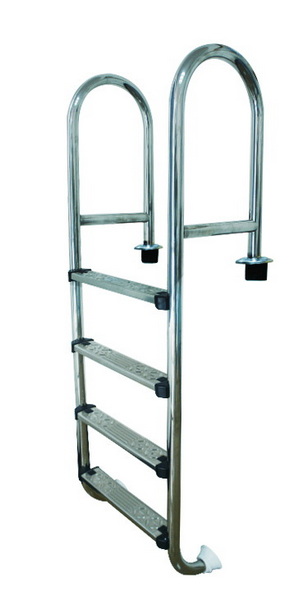
A secure ladder should not rock side to side or front to back when you firmly shake it at the top and bottom. Ask another person to observe while you climb up and down; any visible shifting, creaking, or flexing in the hardware means you need to retighten bolts, improve leveling, or add stabilization accessories like mats or ballast.[8][2][4]
Bricks or concrete blocks can crack liners or create sharp pressure points if used directly under ladder feet inside the pool, so they are generally not recommended. Instead, use flat, non-slip patio stones or commercial ladder pads designed for pools; they spread weight evenly and protect the liner while improving stability.[3][2]
If your steps have built-in ballast chambers, fill them with the recommended amount of sand or water and ensure all caps are properly sealed. For compatible models without chambers, attach smooth, liner-safe weight bags or plates to designated tie points, and expel trapped air by drilling manufacturer-approved vent holes so the structure can fill fully with water.[9][10][4]
Safety guidelines and barrier recommendations strongly support making ladders inaccessible when the pool is unattended, particularly for homes with children. Using removable steps, roll-guards, locking gates, or surrounding fences with self-closing, self-latching gates significantly reduces unauthorized access and drowning risks.[11][12][5][1]
Plan quick weekly checks to confirm all bolts, nuts, and handrails are tight and free of visible rust, plus monthly cleaning of feet, mats, and anchor points. At least once a year, replace worn pads, reapply rust protection on metal components, and re-check deck anchors or ground pads so the ladder stays secure throughout each swim season.[2][3]
[1](https://www.poolfencediy.com/blogs/blog/pool-ladder-safety)
[2](https://www.poolkingfilter.com/how-to-make-an-above-ground-pool-ladder-more-stable.html)
[3](https://www.poolkingfilter.com/how-to-hold-down-a-pool-ladder.html)
[4](https://www.poolkingfilter.com/how-to-secure-above-ground-pool-ladder.html)
[5](https://www.floridahealth.gov/%5C%5C/environmental-health/swimming-pools/_documents/cpsc-safety-barriers.pdf)
[6](https://waterthat.com/blogs/news/the-basics-of-above-ground-pool-steps-and-ladders)
[7](https://www.vevor.com/diy-ideas/heavy-duty-above-ground-pool-ladder/)
[8](https://blog.watsons.com/blog/stabilize-above-ground-pool-ladder)
[9](https://www.youtube.com/watch?v=-qkS06U4SC0)
[10](https://www.reddit.com/r/pools/comments/wubcro/how_to_keep_stairs_down_on_floor_instead_of/)
[11](https://blog.watsons.com/blog/make-above-ground-pool-ladder-stable)
[12](https://www.thepoolfactory.com/blogs/equipment/make-your-pool-safer-simple-steps)
[13](https://www.facebook.com/groups/637529959937311/posts/2689799734710313/)
[14](https://www.youtube.com/watch?v=JJkG7vsan1E)
[15](https://sternsbackyard.com.au/blogs/news/safety-tips-for-installing-and-using-above-ground-pool-ladders)
[16](https://www.facebook.com/groups/637529959937311/posts/2603966996626921/)
[17](https://www.reddit.com/r/AboveGroundPools/comments/13q494j/securing_pool_steps_no_drilling/)
[18](https://dgpoolsupplyandservice.com/step-above-ground-swimming-pool-ladder-w-handle-slip-prevent-32-inch/)
[19](https://www.reddit.com/r/AboveGroundPools/comments/1dmbjtp/pool_ladder_for_fatties/)
[20](https://www.facebook.com/groups/637529959937311/posts/2642320976124856/)


