
Views: 222 Author: Tina Publish Time: 2025-12-20 Origin: Site


Content Menu
● Basic concept of sand filtration
● Main components of a sand pool filter
● Step‑by‑step: filtration mode
>> Backwash: reversing the flow
● Other multiport valve settings
● Sand type, micron rating, and alternative media
● Maintenance and efficiency tips
● How sand filters compare to other pool filters
● FAQs about sand pool filters
>> 1. How often should I backwash a sand pool filter?
>> 2. How long does filter sand last before it must be replaced?
>> 3. What micron size does a sand filter remove?
>> 4. Can I upgrade the media inside a sand filter?
>> 5. Why is my pool still cloudy even though the sand filter is running?
>> 6. Is a sand filter suitable for saltwater pools?
As a professional Chinese manufacturer of premium sand filters, DE filters, cartridge filters, pumps, LED pool lights, and accessories, this guide explains the complete working principle of a sand pool filter for pool owners, installers, and OEM buyers worldwide. Throughout the article you will see suggested images and videos you can add in your CMS to help readers understand the system visually.[3][4]
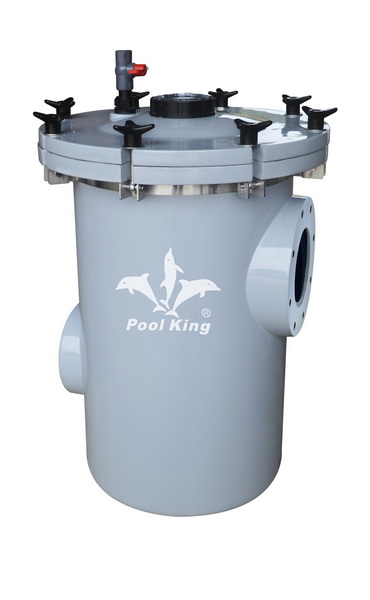
A pool sand filter is a pressure vessel filled with a specific grade of silica sand that removes suspended particles from the water as it flows from the top of the tank to the bottom. The rough, angular surfaces of the sand grains capture debris such as dust, algae, body oils, and other contaminants, while the cleaned water exits through internal laterals and returns to the pool.[5][2][6][1]
- Suggested image: Cross‑section diagram of a sand filter showing water flowing from top inlet, through sand bed, to bottom laterals.
- Suggested video: “POOL SAND FILTERS 101” style explainer demonstrating internal water path and valve positions.[3]
The efficiency of a sand filter is often described by its micron rating, usually around 20–40 microns for standard silica sand media. This level is adequate for most residential and commercial pools, especially when supported by correct chlorine levels and circulation times.[7][8][1]
A typical sand pool filtration system includes the filter tank, multiport valve, internal plumbing, and the circulation pump that provides the necessary pressure.[4][1]
- Filter tank: Usually fiberglass, plastic, or coated steel, engineered to withstand operating pressures and outdoor conditions.[6][4]
- Filter media (sand): Special #20 silica sand with uniform grain size around 0.45–0.55 mm, washed and screened for pool use.[9][2]
- Laterals and standpipe: A hub with slotted arms at the bottom of the tank that collects filtered water and returns it via the standpipe to the valve.[10][6]
- Multiport valve: A top‑mount or side‑mount valve with positions such as Filter, Backwash, Rinse, Waste, Recirculate, and Closed to control the direction of water flow.[11][2]
- Pressure gauge and air relief: Monitor the resistance across the sand bed and help release trapped air from the system.[3][4]
In normal “Filter” mode, the sand filter continuously removes debris while water circulates through the system. Understanding this flow helps pool owners and OEM buyers size equipment correctly and diagnose issues.[4][6]
1. Water intake from pool
The pool pump draws water from:
- Surface skimmers
- Main drain
- Optional vacuum or suction ports
The pump's impeller creates suction on the inlet side and pressure on the outlet side, pushing water toward the filter inlet at the valve.[13][1]
2. Flow into the top of the tank
In Filter position, the multiport valve directs pressurized water from the pump into the top distributor of the sand filter. The water spreads evenly across the upper surface of the sand bed so the entire cross‑section of media is used for filtration.[14][2][6][4]
3. Filtration through the sand bed
As water travels from the top to the bottom of the sand bed, particles are captured by three main mechanisms:[1][5]
- Mechanical straining: Larger debris is physically blocked in the gaps between sand grains.
- Adsorption and adhesion: Finer particles cling to the rough, angular surfaces of the sand.
- Depth filtration: Contaminants are trapped throughout the depth of the bed, not just at the surface.
Standard pool filter sand typically captures dirt in roughly the 20–100 micron range, with many residential systems operating effectively around 30–40 microns. As more debris is trapped, the sand bed becomes denser and slightly more efficient—up to the point where flow resistance becomes too high.[2][7][6][1]
4. Collection by laterals and return to pool
Cleaned water reaches the bottom of the tank and passes through the slotted laterals, which are designed to let water in while holding the sand in place. The water then travels up the standpipe, through the multiport valve, and back to the pool via the return inlets, completing the circulation loop.[10][6][4]
Over time, trapped debris increases the pressure across the sand bed, which is visible on the filter's pressure gauge. When the pressure rises about 8–10 psi above the clean starting value, or at least every few weeks during heavy use, the filter must be cleaned via backwashing.[2][6][1]
In Backwash mode, the water flow through the filter is reversed to flush dirt out of the sand and send it to waste.[15][11]
Basic sequence:
1. Turn off the pump.
2. Move the multiport valve from Filter to Backwash.
3. Turn on the pump and run until the sight glass or discharge water runs clear, usually 1–3 minutes.[1][2]
4. Turn off the pump before changing to the next setting.
During backwash, clean water enters at the bottom of the tank, flows upward through the sand bed, lifts and agitates the sand, and carries loosened debris out through the waste port.[14][4]
After backwash, the Rinse position is used to resettle the sand and prevent dirty water or loose sand from going back into the pool.[12][11]
Typical steps:
1. With the pump off, move the valve to Rinse.
2. Turn on the pump for about 20–60 seconds, sending water top‑to‑bottom through the sand to waste.[11][12]
3. Turn off the pump again, then switch the valve back to Filter and restart for normal operation.
Rinsing ensures the sand bed is compact and stable so water flows evenly through it in the next filtration cycle.[12][4]
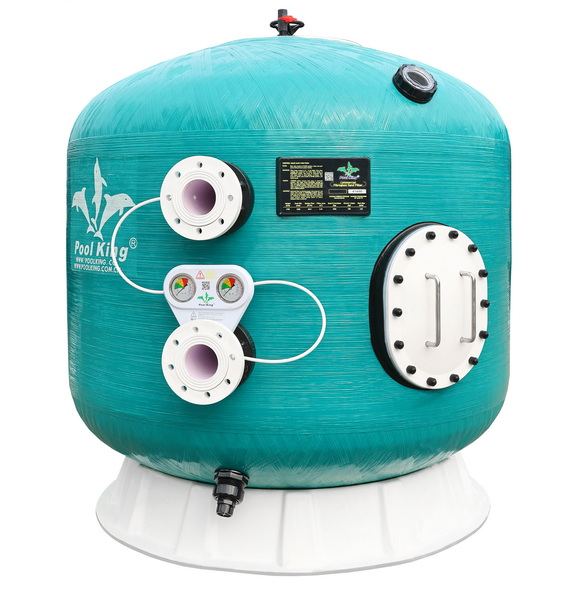
Besides Filter, Backwash, and Rinse, most multiport valves offer additional modes that change how water moves through the system.[13][11]
- Waste / Drain: Bypasses the filter entirely and sends water directly out of the pool, useful for vacuuming heavy debris or lowering water level.[13][12]
- Recirculate / Bypass: Circulates water through the pump and return line without passing through the sand, helpful for chemical mixing or troubleshooting a damaged filter.[3][13]
- Closed: Shuts off flow from the pump; used only when the pump is off to avoid over‑pressurizing the system.[11]
The performance of a sand filter depends heavily on the media inside the tank. For standard pool applications, #20 grade silica sand with uniform particle size is most common.[8][9][2][1]
- Grain size: Approximately 0.45–0.55 mm for optimal flow and debris capture.[9][2]
- Filtration level: About 20–40 microns in many pool systems.[8][7]
- Replacement interval: Often every 3–5 years, depending on bather load and maintenance.[6][1]
If sand is too fine, it can clog quickly and reduce flow; if it is too coarse, particles pass through and water remains cloudy.[9][2]
Many modern sand filters can also use upgraded media for finer filtration.[4][8]
Common options:
- Zeolite: Porous volcanic mineral that can filter down to around 5 microns and adsorb ammonia, improving water clarity and reducing chloramine formation.[8][4]
- Recycled glass: Crushed glass media with smooth surfaces that resists clumping, filters around 5–10 microns, and may last longer with lower backwash water consumption.[4][8]
A sand pool filter is relatively low‑maintenance, but a few habits ensure long‑term performance and energy efficiency.[6][1]
Key tips:
- Monitor the pressure gauge and backwash whenever the reading rises 8–10 psi above clean pressure or at least monthly during the season.[17][2]
- Avoid excessive backwashing to reduce water loss and protect pool chemistry; only backwash when needed, not on a rigid daily schedule.[1][11]
- Maintain proper water level so the pump never runs dry and air does not enter the system, which would reduce filtration efficiency.[6][1]
- Replace sand on the recommended interval or when symptoms like persistent cloudy water and frequent backwashing appear even with correct chemistry.[1][6]
For OEM buyers and professional users, correctly matching filter diameter and media volume to pump flow rate and pool volume ensures efficient filtration while preventing channeling or over‑pressure inside the tank.[8][6]
While this article focuses on sand filters, many customers compare them to cartridge and DE systems before selecting equipment. The table below gives a quick overview.[7][1]
Pool filter types overview
| Feature | Sand filter | Cartridge filter | DE filter |
|---|---|---|---|
| Typical micron rating | ~20–40 micronspoolproswi+1 | ~5–20 micronsfreshwatersystems+1 | ~1–6 micronsfreshwatersystems |
| Cleaning method | Backwash + rinsefreshwatersystems+1 | Remove and hose cartridgesfreshwatersystems | Backwash + add DE powderfreshwatersystems |
| Media replacement | 3–5 yearsfreshwatersystems+1 | 1–3 yearsfreshwatersystems | 5–10 years (grids), frequent DEfreshwatersystems |
| Initial cost | Lowestfreshwatersystems | Mediumfreshwatersystems | Highestfreshwatersystems |
| Maintenance complexity | Lowgreatbackyard | Moderatefreshwatersystems | Higherfreshwatersystems |
Sand filters offer a reliable, cost‑effective solution with simple operation, making them ideal for many residential and commercial installations worldwide.[6][1]
A sand pool filter works by forcing water under pressure through a bed of specially graded sand, where debris is trapped between rough grains while clean water returns to the pool. Over time, accumulated dirt is removed by reversing the flow in a backwash cycle and then resettling the sand with a short rinse to restore normal filtration. When paired with the right pump, proper chemical balance, and periodic maintenance such as backwashing and media replacement, a sand filter provides a durable, low‑cost solution for clear, safe pool water in both residential and commercial environments.[15][5][1][4][6]
Most pools need backwashing whenever the filter pressure is about 8–10 psi higher than the clean starting pressure, which often works out to roughly once every few weeks during heavy use.[2][1]
Pool filter sand typically lasts about 3–5 years, but high bather loads, poor water chemistry, or frequent algae problems may shorten this interval.[1][6]
Standard silica sand in pool filters usually captures particles in the range of roughly 20–40 microns, which is sufficient for clear water when supported by correct chlorine levels.[7][8]
Many modern sand filter tanks can be filled with alternative media such as glass or zeolite, which can filter down to about 5–10 microns and may last longer or offer improved clarity compared with traditional sand.[4][8]
Cloudy water can result from undersized equipment, clogged or worn‑out sand, insufficient run time, or poor chemical balance, so checking filter pressure, sand age, circulation hours, and water chemistry is essential.[6][1]
Yes, sand filters are widely used on both freshwater and saltwater pools; the key is to select corrosion‑resistant tanks and valves and maintain proper salt and chemical levels recommended for the system.[18][6]
[1](https://www.freshwatersystems.com/blogs/blog/how-does-a-pool-filter-work)
[2](https://intheswim.com/eguides/sand-pool-filters.html)
[3](https://www.youtube.com/watch?v=VmXdio44FTY)
[4](https://www.youtube.com/watch?v=ugx2lRgGhz0)
[5](https://poolpartstogo.com/blogs/pool-equipment/how-does-a-pool-sand-filter-work)
[6](https://greatbackyard.com/blogs/news/everything-you-need-to-know-about-your-pools-sand-filter)
[7](https://www.poolproswi.com/post/everything-you-need-to-know-about-pool-filters)
[8](https://platinumpoolservice.com/blog/what-is-the-best-filter-media-for-my-sand-filter/)
[9](https://beatbot.com/blogs/pool-cleaning-kits/different-types-of-sand-for-pool-filters-and-how-to-choose-the-right-one)
[10](https://www.riverpoolsandspas.com/blog/pool-sand-filter-cost-maintenance-benefits)
[11](https://hyclor.com.au/how-to-correctly-backwash-a-pool-filter/)
[12](https://hollandiagardens.com/pool-filter-settings-explained/)
[13](https://www.youtube.com/watch?v=id-zD7fbolE)
[14](https://royalbrinkman.com/knowledge-center/technical-projects/water-filter-technologies-horticulture/sand-filter)
[15](https://hyclor.com.au/how-does-a-pool-sand-filter-work/)
[16](https://www.youtube.com/watch?v=TqSPuekohqQ)
[17](https://www.facebook.com/groups/637529959937311/posts/2574669099556711/)
[18](https://netpositivepools.com/blog/sand-filter-vs-cartridge-filter/)
[19](https://www.youtube.com/watch?v=IoumNs3gj7E)
[20](https://www.reddit.com/r/pools/comments/1d9ogxh/first_sand_filter_what_do_you_wish_youd_known/)


