
Views: 222 Author: Tina Publish Time: 2025-12-30 Origin: Site


Content Menu
● Can a Pool Ladder Be Adjusted to Your Pool's Height?
● Understanding Pool Ladder Types and Heights
● How Adjustable Pool Ladders Work
>> Height-Adjustment Mechanisms
>> Weighting and Stabilizing the Ladder
● Measuring Your Pool to Choose the Right Ladder
>> Measuring Above-Ground Pool Wall Height
>> Measuring In-Ground Pool and Deck Height
● Safety, Compatibility, and Common Mistakes
>> Compatibility with Pool Type and Brand
● When to Adjust Versus Replace Your Pool Ladder
>> Signs Your Ladder Does Not Match Pool Height
>> Benefits of Upgrading to a Height-Adjustable System
● FAQs About Pool Ladder Height and Adjustment
>> 1. How do I know what ladder size I need?
>> 2. Can one ladder fit different pool heights?
>> 3. Do I need to add weight to my above-ground pool ladder?
>> 4. Are adjustable ladders safe for children?
>> 5. Can I use an A-frame ladder on a soft-sided or inflatable pool?
>> 6. When should I replace my pool ladder instead of adjusting it?
A pool ladder is not one‑size‑fits‑all; different models are designed to fit specific height ranges such as 42–48 inches, 48–54 inches, or 48–56 inches for above‑ground pools. Many A‑frame and deck‑mount ladders are factory‑adjustable, while in‑ground ladders are usually “self‑accommodating” within standard wall depths and adjusted mainly at the anchor points.[5][2][6][1]
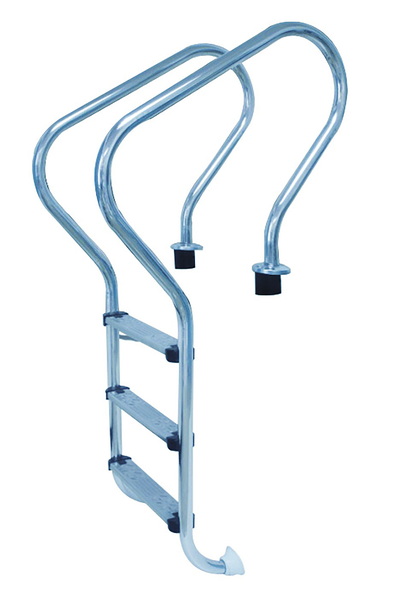
Different ladder types match different pool structures and heights, so choosing correctly is critical for safety and comfort.[2][7]
Above‑ground pool ladders are usually built around standard wall heights of 42, 48, 52, and 54 inches. Many models specify an adjustable range, such as 48–54 inches or 48–56 inches, meaning the same ladder can be tailored to pools of different heights.[8][9][4][1][5]
- A‑frame ladders: Straddle the pool wall with steps on both sides and often adjust to 48–56 inch pools.[10][8]
- Deck‑to‑pool ladders: One side mounts on the deck and the other descends into the pool, with rails or legs that adjust to deck heights like 46–56 inches.[11][10]
- Step systems: Wide staircase‑style units for easier entry that can fit 48–54 inch pool walls without complex adjustments; they are “fine‑tuned” by how they are anchored and weighted.[6][2]
In‑ground ladders generally fit standard pool depths and are adjusted at installation, not by changing ladder height itself.[12][2]
- Stainless‑steel 3‑step or 4‑step ladders are designed to serve typical shallow‑end depths and can accommodate small variations in deck height due to the way they're anchored.[2][6]
- Some resin or polymer‑coated ladders have fixed step spacing but can be matched to pools up to specific depths, such as 60 inches.[5]
Adjustable ladders are engineered with telescoping or modular components so they can fit a range of pool heights safely.[1][8]
Typical adjustment methods include:
- Telescoping legs or rails
- Ladder legs slide up or down and are locked with pins or snap‑lock fasteners to match pool wall or deck height.[8][10]
- Removable or re‑positionable treads
- Some A‑frame ladders let you add or remove steps or change their mounting position to match 48, 52, or 54 inch walls.[1][5]
- Deck‑mount bracket adjustment
- On many in‑pool or deck‑to‑pool ladders, minor height differences are absorbed when you position and secure the top mounting flanges on the deck.[11][2]
Ensuring the ladder sits solidly on the pool floor is just as important as matching the height.[6][2]
- Many A‑frame and step systems for above‑ground pools require sand or small pebbles poured into the hollow sides or steps for ballast.[2][6]
- Some designs specify about 40 pounds total, often 20 pounds on each side of the step structure.[6]
- Stable contact with the pool floor prevents the ladder from floating, rocking, or chafing the liner.
Correct measurement is the foundation for choosing a ladder that fits and adjusts correctly.[3][4]
Above‑ground pools tend to have standardized heights, but verifying your exact wall height is essential.[9][4]
- Measure from the ground to the very top of the wall, under the top rail, on the outside of the pool.[4][13]
- Typical wall heights are 48, 52, or 54 inches, but some models are 42 inches or non‑standard; check carefully.[14][9]
- For step systems and liners, the “effective” depth is measured from the deepest point of the floor to the top inside edge where the liner hooks, which often correlates with those standard heights.[9]
For in‑ground pools, measurement focuses on deck level and water depth rather than a wall panel height.[14][2]
- Measure from the deck surface down to the pool floor where the bottom step will rest to estimate needed step count and ladder style.[12][2]
- Check that the ladder model is rated for your pool's depth and that the handrails extend high enough above the deck for safe gripping.[7][5]
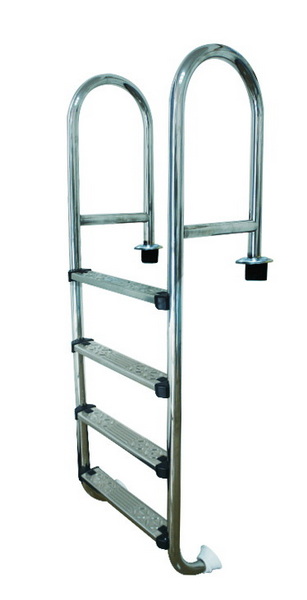
Ladder adjustment is not only about convenience; it directly affects swimmer safety and pool structure protection.[15][2]
A correctly sized and adjusted ladder reduces slip and fall risk and protects liners from damage.[15][2]
- Steps should be fully submerged, with enough clearance that swimmers can step naturally without over‑reaching.[2][6]
- Handrails should give a secure grip above deck or top rail and not wobble when weight is applied.[5][11]
- Many safety A‑frame ladders include lockable or removable outside steps to block unsupervised access by children.[16][2]
Not every ladder fits every pool, even if the height matches.[1][5]
- Some heavy‑duty A‑frame ladders are not recommended for soft‑sided or inflatable pools and are designed for steel‑wall above‑ground pools only.[5][1]
- Weight capacity ratings (for example 250, 300, or 400 pounds) vary; commercial or high‑use installations should choose higher‑capacity models.[7][1][5]
- Deck‑mount flanges and rail shapes differ; confirm that the anchor hardware is compatible with your deck surface and pool coping.[12][5]
Sometimes adjustment alone is not enough and a new ladder or step system is the better solution.[17][2]
If the ladder is far from matching the pool height range for which it was designed, safety may be compromised.[3][4]
- Top platform sits significantly below top rail or deck, forcing swimmers to “climb up” without a handhold.
- Bottom step is suspended above the floor, creating a large last step that is hard to navigate.
- Handrails do not extend to a comfortable grab height above deck or top rail.
In such cases, replacing the ladder with a model that properly overlaps your pool's measured height (for example 48–54 inches) is usually safer than forcing an improvised adjustment.[8][1]
Modern adjustable ladders and step systems improve safety, comfort, and aesthetics.[18][2]
- Height‑adjustable ladders can be reused if you change to a slightly taller or shorter above‑ground pool, within their range.[10][1]
- Wider tread designs and staircase systems are easier for children, seniors, and people with limited mobility.[18][2]
- Many new products use corrosion‑resistant resin and stainless steel that stand up better to treated water and outdoor weather.[1][5]
A pool ladder can absolutely be adjusted to your pool's height as long as you select a ladder whose design and adjustable range match the measured height of your pool wall or deck. By understanding your pool type, measuring accurately, and following manufacturer instructions for height adjustment, weighting, and anchoring, you ensure safe, comfortable, and durable access to the water for every swimmer.[4][3][8][6][2][1]
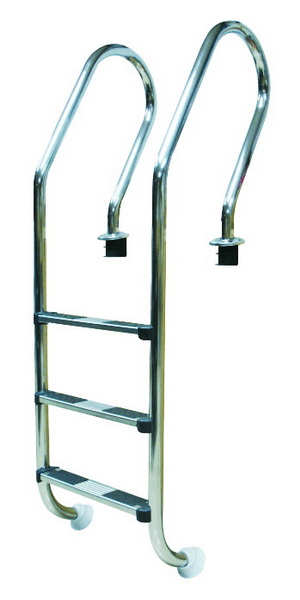
Measure the full height of your above‑ground pool wall from the ground to the top rail, or the deck‑to‑floor distance for in‑ground pools, then compare it to ladder models labeled for ranges like 48–54 inches or 48–56 inches. Choose a ladder that overlaps your measurement and provides at least one or two steps fully underwater for safe entry.[13][3][4][6][2]
Yes, many A‑frame, deck‑to‑pool, and step‑style ladders are adjustable to cover multiple wall heights, such as 48, 52, and 54 inches, using telescoping rails or adjustable treads. This flexibility allows a single ladder model to work with various pools or future upgrades, provided you stay within its specified range and weight capacity.[10][7][8][1]
Most above‑ground step systems and some A‑frame ladders must be weighted with sand or pebbles in their hollow sides or steps so they sit firmly on the pool floor and do not float. Always follow the manufacturer's recommended ballast weight, which may be around 40 pounds distributed equally between both sides.[6][2]
Adjustable ladders from reputable manufacturers are designed with non‑skid steps, sturdy handrails, and safety features, and many A‑frame models offer lockable or removable outside steps to prevent unsupervised access. When properly installed to the correct height and locked when not in use, these ladders are an important part of a comprehensive pool‑safety strategy that also includes fencing and supervision.[16][15][2]
Not all A‑frame ladders are compatible with soft‑sided or inflatable pools; some heavy‑duty models are intended only for rigid steel‑wall pools and may damage softer walls or be unstable. Always check the product description and compatibility notes, and select a ladder specifically rated for your pool construction type.[17][5][1]
If your ladder's maximum adjustable height does not reach your pool's wall height, if the bottom step cannot rest properly on the floor, or if the handrails remain too low to grip safely even after adjustment, replacement is the safer choice. Also replace ladders that show cracks, severe rust, or loose structural components that cannot be repaired according to manufacturer guidelines.[3][15][4][2]
[1](https://www.poolsupplies.com/product/aqua-select-resin-a-frame-heavy-duty-48-54--h-above-ground-ladder)
[2](https://intheswim.com/above-ground-pool-ladders-steps/)
[3](https://blog.watsons.com/blog/install-above-ground-pool-ladder)
[4](https://www.poolsupplies.com/blog/post/how-to-properly-measure-your-pools-wall-height)
[5](https://www.lowes.com/pl/Above-ground-pool-ladders-steps-Pool-ladders-lifts-Pools-Outdoors/4294610238)
[6](https://poolpartstogo.com/blogs/pool-equipment/how-to-fit-a-ladder-to-your-above-ground-pool-the-right-way)
[7](https://www.americansale.com/collections/pool-ladders-and-steps)
[8](https://www.sunnyspoolsandmore.com/pools/ladders/)
[9](https://linerworld.com/blogs/resources/how-do-i-measure-my-above-ground-pool-for-a-liner)
[10](https://poolandspasupplystore.com/pools-and-equipment/above-ground-pool/ladders-and-steps)
[11](https://www.doheny.com/confer-heavy-duty-inpool-ladder-for-decks-42-56)
[12](https://www.poolwarehouse.com/product-category/pool-equipment-accessories/swimming-pool-rails-and-ladders/pool-ladders/page/2/?filters=pool-ladders%5Babove-ground-pool-ladders%5D)
[13](https://www.poolkingfilter.com/what-size-pool-ladder-do-i-need.html)
[14](https://www.poolwarehouse.com/articles/how-to-choose-the-perfect-pool-wall-height-42-48-or-52/)
[15](https://www.poolsupplies.com/shop/accessories-ladders)
[16](https://www.poolsandstuff.com/pool-steps-ladders/show-all.html)
[17](https://www.thepoolfactory.com/collections/above-ground-pool-ladders)
[18](https://www.royalswimmingpools.com/above-ground-pool-ladders-steps.html)
[19](https://www.homedepot.com/b/Outdoors-Pool-Supplies-Pool-Accessories-Pool-Ladders/Adjustable-Height/N-5yc1vZcfz3Z1z1bibz)
[20](https://www.poolzoom.com/category/aboveground-pool-ladders.html)


