
Views: 222 Author: Tina Publish Time: 2025-12-27 Origin: Site


Content Menu
● Safety risks of a floating ladder
● How to diagnose why yours floats
● Step‑by‑step fixes to stop floating
>> Add internal ballast (sand or weights)
>> Improve anchoring to deck or top rail
>> Check if your ladder is the right design
● Best practices to prevent future floating
● When to replace your pool ladder
● OEM pool ladder and accessory solutions
● FAQs about floating pool ladders
>> 1. Why does my new pool ladder float even though it is installed?
>> 2. Is it safe to drill holes in my pool ladder to stop it floating?
>> 3. Can I just tie weights to the bottom of my ladder?
>> 4. Why does my ladder still float even after I filled it with sand?
>> 5. How do I know if my ladder is safe for kids?
>> 6. Should I replace a rusted metal ladder that still feels solid?
>> 7. Can OEM pool ladders be customized to avoid floating problems in my market?
A floating pool ladder usually means trapped air, not enough internal weight, or improper anchoring to the pool wall or deck. These issues reduce stability and create safety risks for swimmers, especially kids and older people.[1][2][3][4]
As a professional Chinese factory manufacturing premium sand filters, DE filters, cartridge filters, pool pumps, LED pool lights, and pool accessories, OEM pool ladders and steps are also supplied for overseas brands, wholesalers, and manufacturers that need safer, non‑floating access systems.
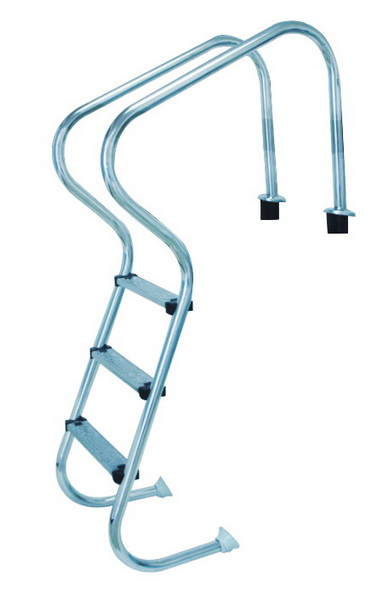
Most floating ladders share the same basic physical causes.[4][1]
- Trapped air inside hollow ladder steps or rails increases buoyancy and pushes the ladder upward.[5][6][1]
- Insufficient internal ballast (sand or weights) means water cannot overcome the ladder's natural buoyancy.[7][1]
- Ladder not bolted or clipped to the pool top rail or deck allows it to lift and “walk” when people climb.[8][3]
- Design not matched to your pool type (for example, free‑standing A‑frame ladder in a deep above ground pool) can make the base unstable and easier to float.[3][9]
- Poor installation, such as leaving factory vent plugs closed or not filling the built‑in weight chambers, leads to persistent floating.[1][4]
A floating or unstable ladder is not just annoying; it is a real safety problem.[2][10]
- Sudden ladder movement can cause slips, falls, and leg injuries when swimmers put weight on a step that lifts or twists.[2][3]
- Children may become trapped between a floating step and the pool wall if there is space to slide behind the ladder.[10][11]
- Floating ladders can damage pool liners when they bang or scrape against the wall repeatedly.[6][1]
Pool safety organizations recommend secure, non‑slip steps, stable handrails, and barriers that prevent children from climbing into or behind the ladder. For above‑ground pools, removable or lockable ladders are also recommended when the pool is not in use.[3][10][2]
Before fixing the problem, identify exactly what is happening with your ladder.[1][4]
- Press the steps down under water and look for bubbles; continuous bubbling usually means trapped air inside chambers.[12][1]
- Gently pull the ladder away from the wall or deck; if it lifts easily, it is not properly anchored or heavy enough.[8][1]
- Check for factory‑marked fill ports for sand or weights and see whether they are actually filled.[4][1]
- Inspect any vent or drain holes; if you see sealed plugs where the manual shows vents, air may be locked inside.[13][1]
Once the cause is clear, you can apply one or more of the following methods to keep the ladder down.[4][1]
Many ladders and steps float simply because air cannot escape.[12][1]
- With the pool ladder or steps in the water, slowly tilt them side to side until bubbles stop rising from vents and openings.[12][1]
- In some cases, you may need to remove the ladder, turn it on its side, and submerge it slowly so water replaces internal air.[6][12]
- If air pockets remain, some owners carefully drill small holes in non‑structural areas to allow water in and air out, following manufacturer guidance where possible.[5][13][6]
Many molded steps and ladders are designed to be filled with ballast.[1][4]
- Some models specify about 70 lb of sand, split between several internal chambers, to keep the steps firmly on the pool floor.[1]
- Use dry play sand or other approved ballast, and fill through the designated fill holes until they are fully packed.[4][1]
- Close any caps or plugs exactly as the manual describes so ballast stays inside while allowing vents to remain open.[1]
Alternative ballast methods, such as vinyl‑coated weights or sealed weight bags, are sometimes used when sand filling is not possible, but they must be placed safely where they cannot tear the liner.[7][6]
Above‑ground ladders and in‑pool steps should be fixed securely to the deck or pool top rail.[8][3]
- A‑frame and in‑pool ladders often include deck connectors that must be screwed into the deck with self‑tapping screws.[3][1]
- If your ladder is not bolted or clipped, add proper anchor brackets rated for pool use instead of improvising with ropes or bungee cords.[10][8]
- Maintain a small gap (often about 1 inch) between the back of the ladder and the pool wall to protect the liner, as some instructions specify.[1]
Sometimes a ladder floats because its design does not suit the pool environment.[9][3]
- Lightweight plastic ladders meant for shallow above‑ground pools may be too buoyant or unstable in deeper or larger pools.[9][3]
- Inground pools with curved walls or benches may need specially curved or integrated steps rather than a generic straight ladder.[9]
- When upgrading, choose ladders with wide non‑slip treads, strong handrails, and corrosion‑resistant materials such as stainless steel or high‑grade resin.[2][9]
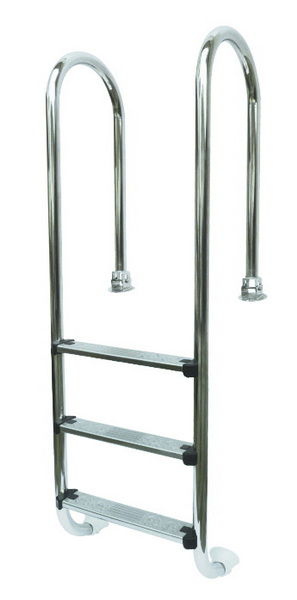
Once fixed, a ladder can stay stable for many seasons with basic maintenance.[4][1]
- Inspect fill caps, weight bags, and bolts at the start of each swim season and after major storms or high usage.[3][1]
- Rinse steps after winterizing and check for cracks or leaks that might allow ballast loss or new air pockets.[9][1]
- For above‑ground pools, consider locking or removing the outside ladder when not in use, following safety recommendations.[10][2]
Repair is not always the safest long‑term solution.[2][9]
- Replace ladders with cracked risers, broken treads, or rusted handrails that could suddenly fail under load.[2][9]
- If your ladder repeatedly floats even after refilling ballast and releasing air, the internal structure or design may not be adequate.[4][1]
- Upgrading to a newer ladder with built‑in ballast chambers, wider steps, and better handrail ergonomics can improve both safety and comfort.[10][2]
For brands, wholesalers, and pool equipment manufacturers, customizing ladder design can prevent floating issues from the start.[4][9]
- OEM ladder systems can integrate pre‑engineered ballast chambers, optimized venting, and reinforced mounting points for specific pool wall heights and deck types.[9][4]
- Matching ladders with compatible sand filters, pumps, and LED lights in a unified equipment package gives distributors consistent quality and easier after‑sales support.
A professional Chinese plant using smart machinery can offer private label ladders, entry steps, and full filtration/light kits tailored to regional safety guidelines and branding requirements.
A pool ladder floats mainly because buoyant air is trapped inside hollow sections, there is not enough ballast, or the ladder is not securely anchored to the pool structure. By releasing trapped air, adding the correct internal weight, and properly bolting the ladder or steps to your deck or pool rail, most floating problems can be solved and safety significantly improved. For long‑term reliability, choosing a ladder designed for your specific pool type—and, for OEM buyers, specifying anti‑floating features during production—helps keep access stable, comfortable, and safe for all swimmers.[8][2][3][4][9][1]
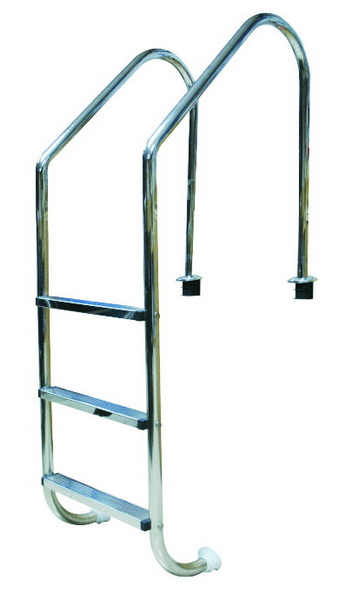
New ladders often ship with hollow steps that must be filled with sand or other ballast, or vented so water can enter. If the ballast chambers are empty or vents are closed, trapped air makes the ladder buoyant and causes it to float.[5][4][1]
Many pool owners drill small holes in non‑structural areas to let air out and water in, but it must be done carefully to avoid weakening the ladder or creating sharp edges. Always check your manufacturer's guidance, smooth any drilled edges, and never drill into critical load‑bearing parts.[13][6][5][4][1]
External weights can help, but if they move or slip, they may damage the liner or create tripping hazards. Built‑in ballast chambers or manufacturer‑approved weight kits are usually a safer and cleaner solution than loose objects.[7][6][4][1]
If air remains trapped in other parts of the ladder, or if the specified amount of sand was not added to all chambers, it may still be buoyant. Check for additional vents that need opening, confirm you used the recommended weight, and make sure no sand has leaked out through cracks.[12][4][1]
A safe ladder has non‑slip steps, sturdy handrails on both sides, adequate step width, and no sharp or exposed fasteners. For above‑ground pools, it should also be removable or lockable so children cannot climb into the pool unsupervised.[14][10][2]
Even if it feels solid today, rust weakens metal over time and can lead to sudden failure under load. Upgrading to a corrosion‑resistant stainless steel or composite ladder with modern safety features is recommended once significant rust appears.[2][9]
Yes, OEM ladder designs can be engineered with specific ballast capacities, vent patterns, and mounting hardware to suit regional pool types and safety standards. A specialized manufacturer can also match ladders with branded filters, pumps, and LED lighting to create complete private‑label pool equipment packages.[4][9]
[1](https://www.thepoolfactory.com/blogs/equipment/how-prevent-pool-steps-from-floating)
[2](https://www.poolfencediy.com/blogs/blog/pool-ladder-safety)
[3](https://sternsbackyard.com.au/blogs/news/safety-tips-for-installing-and-using-above-ground-pool-ladders)
[4](https://www.poolkingfilter.com/how-to-stop-pool-ladder-from-floating.html)
[5](https://www.facebook.com/groups/637529959937311/posts/2536582576698697/)
[6](https://www.facebook.com/groups/637529959937311/posts/2594449264245361/)
[7](https://www.poolspaforum.com/forum/index.php?%2Ftopic%2F1059-weighing-pool-steps-downalternative-for-sand%2F)
[8](https://www.thepoolfactory.com/a/answers/6442767/Why-won-t-my-pool-ladder-stay-down)
[9](https://www.svadonpoolcn.com/slug-a-comprehensive-guide-to-inground-pool-ladders-safety-selection-and-maintenance/)
[10](https://poolfence.com/pool-ladders-a-step-toward-safety/)
[11](https://www.swimmingpool.com/resources/safety-guides/safety-guidelines/)
[12](https://www.youtube.com/watch?v=pacoHDlvEAE)
[13](http://www.poolforum.com/pf2/showthread.php/194-Pool-ladder-won-t-stay-down-in-pool)
[14](https://www.poolfencediy.com/blogs/blog/pool-ladder-safety?srsltid=AfmBOoq-xbyY49tzdZQ1IiU15lBexLLLVolNjHmMEwWRibkIQd6u18Xm)
[15](https://www.perplexity.ai/search/325853f4-0347-4fb1-ad49-41de60817d7e)
[16](https://www.youtube.com/watch?v=-qkS06U4SC0)
[17](https://www.reddit.com/r/pools/comments/wubcro/how_to_keep_stairs_down_on_floor_instead_of/)
[18](https://www.facebook.com/groups/637529959937311/posts/2639628419727445/)
[19](https://www.law.cornell.edu/cfr/text/16/1207.5)
[20](https://www.ecfr.gov/current/title-16/chapter-II/subchapter-B/part-1207)
[21](https://poolie.com/blog/general/enhance-pool-safety-with-handrail-and-ladder-installation/)


