
Views: 222 Author: Tina Publish Time: 2026-01-28 Origin: Site


Content Menu
● What Does “16 Inch Pool Filter” Really Mean?
● How Much Sand for a 16 Inch Pool Filter?
● Why the Correct Sand Quantity Matters
>> Freeboard – The “Breathing Space” of the Sand Bed
● Choosing Media Types for a 16 Inch Pool Filter
>> Standard #20 Silica Pool Filter Sand
>> Glass Media
>> Should You Mix Different Media Types?
● Step‑by‑Step: Filling a 16 Inch Pool Filter with Sand
>> 2. Open the Filter and Inspect Internals
>> 8. Initial Backwash and Rinse
● How a 16 Inch Pool Filter Fits into Overall Pool Sizing
● Maintenance Tips for a 16 Inch Pool Filter
● Troubleshooting Common Problems with a 16 Inch Pool Filter
>> Cloudy Water Even After Backwashing
>> Rapid Pressure Rise After Cleaning
● FAQ – How Much Sand for a 16 Inch Pool Filter?
>> 1. How many pounds of sand does a 16 inch pool filter need?
>> 2. Can I use less sand than recommended if my pump is small?
>> 3. How much zeolite or glass media should I add to a 16 inch pool filter?
>> 4. How often should I change the sand in a 16 inch pool filter?
>> 5. Can I mix different media types together in my 16 inch pool filter?
Whether you maintain a residential swimming pool or manage small commercial water facilities, the 16 inch pool filter is one of the most widely used sand filter sizes on the market. Knowing exactly how much sand to add is essential for water clarity, energy efficiency, and the long‑term health of your circulation system. For most standard models, a 16 inch pool filter requires around 100 pounds (about 45 kg) of #20 silica pool filter sand, although some designs may specify up to 110–120 pounds.
As a professional Chinese manufacturer specializing in top‑end sand pool filters, DE filters, cartridge pool filters, pool pumps, LED lights, and accessories, we design and produce OEM/ODM systems for international brands, wholesalers, and pool equipment manufacturers. Our smart production lines and strict quality control help ensure that each 16 inch pool filter has the correct internal geometry, media bed height, and hydraulic performance so that the specified amount of sand works exactly as intended.
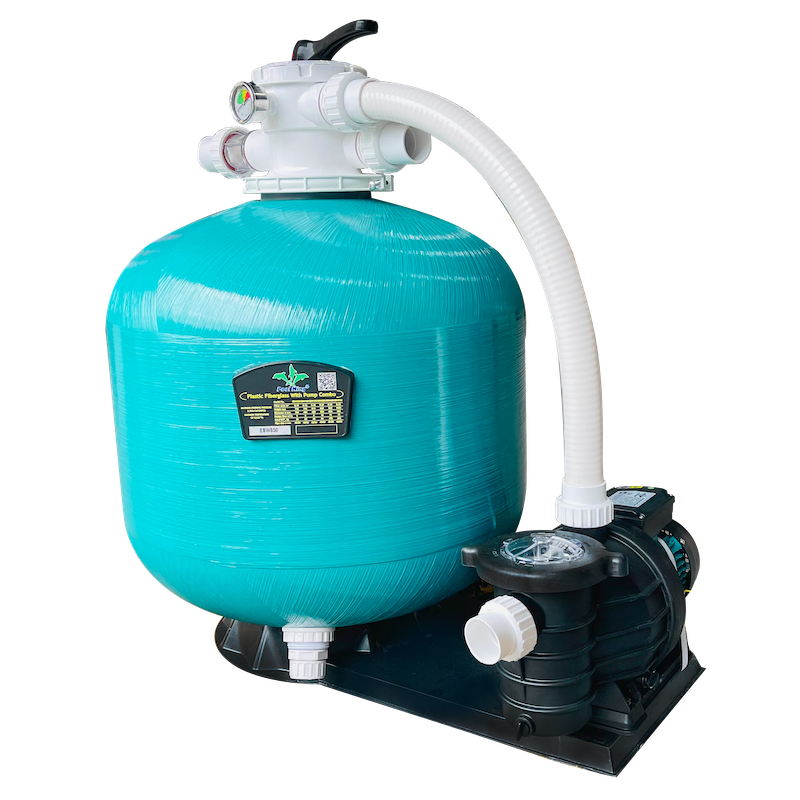
When we talk about a 16 inch pool filter, we are usually referring to the diameter of the filter tank. This is the widest point of the sand filter body, not the height. A 16 inch diameter translates into a certain internal surface area and media bed volume, which is why most charts and manufacturers converge on similar sand capacities for this size.
For typical residential pools, a 16 inch pool filter is often paired with a small to medium‑sized pump, handling filtration needs for above‑ground or smaller in‑ground pools. Because the tank is compact, the correct fill quantity is even more critical than with larger filters — a relatively small error in sand level can significantly change the performance of the system.
Most model‑specific charts and equipment guides indicate that a 16 inch pool filter should be loaded with about 100 pounds of #20 silica pool filter sand. This value appears consistently in many sizing and replacement charts and is a very reliable reference point for standard silica media. Some high‑capacity or deeper‑body designs may specify up to 110–120 pounds, but these models are clearly labeled by the manufacturer.
In other words, if you are filling a standard 16 inch pool filter with silica sand for the first time or after a complete media change, you can usually plan on two 50‑lb bags of pool filter sand. Always confirm on the product label, data plate, or instruction manual of your specific model, because the internal height and underdrain design can vary slightly between brands.
Many independent charts for sand filters show something like:
- 16 inch pool filter – 100 lb sand
- 18 inch pool filter – 150 lb sand
- 19 inch pool filter – 175 lb sand
- 20 inch pool filter – 200 lb sand
This pattern illustrates how capacity scales with diameter. At the 16 inch level, the tank volume and recommended freeboard (empty space above the sand) together arrive at roughly 100 pounds as the ideal balance.
Some 16 inch pool filter systems are built with slightly taller tanks, thicker sand beds, or additional internal components. When this is the case, the label may indicate 110 lb or 110–120 lb of sand rather than exactly 100 lb. The differences are not huge, but they matter for consistent performance over years of operation.
As an OEM manufacturer, we adjust the tank internal height, diffuser shape, and lateral arrangement so that the recommended sand weight corresponds to a sand bed position that leaves enough freeboard for proper backwashing, but still provides a deep enough filtration layer.
Putting the right amount of media into your 16 inch pool filter is not just a technical detail. It directly affects how clean your water is, how often you must perform maintenance, and how long your pump and filter components last.
Using less sand than recommended can cause several problems:
- Reduced filtration efficiency: A shallow media bed provides less contact time and fewer layers for trapping dirt and fine particles, so the pool water becomes cloudy more easily.
- Channeling: Water will seek the path of least resistance, forming channels through weak spots in the bed. Once this happens, a portion of the water bypasses the sand entirely, flowing straight through the pool filter without proper purification.
- Frequent backwashing: With too little sand, the bed loads with debris faster, so you may notice pressure rising quickly and needing to backwash more often, wasting water and time.
Overfilling is also risky:
- Restricted freeboard: A 16 inch pool filter needs a free space above the sand so the bed can expand and move during backwash. If sand reaches too close to the top, there is no room for proper bed expansion.
- Poor backwashing: Without enough room for turbulence, dirt tends to stay embedded in the upper layers of sand, so backwashing may fail to fully clean the bed. Over time, the filter clogs more quickly and requires longer backwash cycles.
- Increased pressure and wear: Too much sand can increase the resistance across the bed, causing higher operating pressure and possible stress on o‑rings, unions, valves, and even the pump.
Most well‑designed 16 inch pool filters are meant to be filled so that the top of the sand bed ends several inches below the internal diffuser or standpipe. This open space is called freeboard. In a typical 16 inch pool filter, freeboard is often in the range of 6–8 inches.
The freeboard allows the sand to expand and move during backwash. This expansion is necessary to break up dirt pockets, release trapped particles, and prevent long‑term compaction. Our factory calibrates the tank height for each 16 inch model so that when the recommended sand weight is added, the resulting bed leaves exactly the freeboard the engineering team has specified.
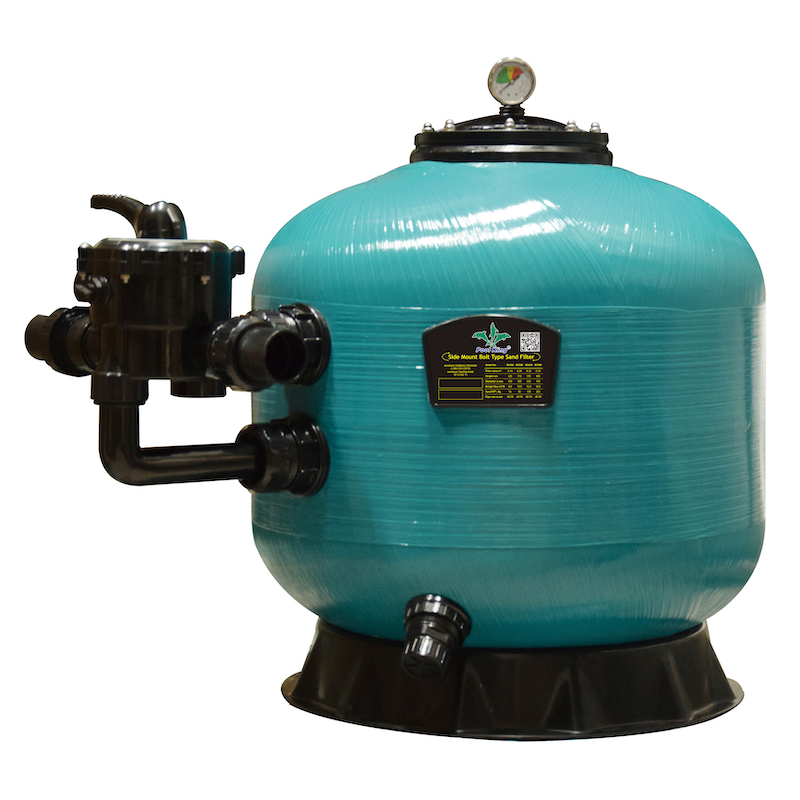
The most common and economical choice is #20 silica pool filter sand. This is a specific grade of quartz sand designed for pool filters, usually with grain sizes around 0.45–0.85 mm. It is different from construction sand or beach sand and should not be substituted.
With #20 silica sand, a 16 inch pool filter typically uses about 100 lb, corresponding to the recommended bed depth and freeboard. Silica sand captures particles roughly down to the 20–40 micron range, which is adequate for most residential pools when combined with proper circulation and chemical management.
Zeolite is a volcanic mineral often marketed as an upgrade to sand. It has a porous structure and can remove smaller particles, sometimes down to the single‑digit micron range. Zeolite can also help absorb certain nitrogen compounds, which may reduce chloramine formation and improve water comfort.
A major advantage for a 16 inch pool filter is that zeolite usually requires only about half the weight of media compared to silica. So if the label states “100 lb silica,” the zeolite recommendation may be around 50 lb. This conversion is frequently specified by manufacturers of complete 16 inch sand filter systems offering zeolite as an alternative.
Glass media, typically made from recycled glass, is another premium option for a 16 inch pool filter. It is lighter than sand, resists channeling better, and often needs shorter backwash cycles. Some manufacturers also claim that glass media supports less bacterial growth due to its smoother surface.
As with zeolite, the amount of glass media, by weight, may be lower than silica for the same tank volume because of its density. In many systems, around 50–60 lb of glass media is considered equivalent to 100 lb of silica in a 16 inch pool filter, but you must follow the media supplier's exact instructions.
In most cases, mixing silica, zeolite, and glass in the same 16 inch pool filter is not recommended unless the manufacturer specifically allows it. Different materials have different densities and grain characteristics, so they naturally separate into layers. This can lead to uneven filtration, dead zones, or channeling.
When converting a 16 inch pool filter from silica to zeolite or glass, the best practice is to remove all old sand, clean the tank thoroughly, rinse the laterals, and then add the new media type according to its recommended weight and procedure.
Below is a practical guide you can use as a reference checklist when filling or refilling your 16 inch pool filter. This procedure can also be transformed into a clear how‑to video script.
- Turn off power to the pump and ensure all valves are closed.
- Release any built‑up pressure from the system before opening the pool filter.
- Place the multi‑port valve in the “Closed” or “Winter” position if it is mounted on the filter, or disconnect it if it is separate.
- Remove the clamp or locking ring on the 16 inch pool filter and take off the lid or dome.
- Inspect the internal standpipe and lateral assembly. Confirm that laterals are unbroken, fully installed, and free from old sand clumps.
- Check for an internal “sand level” mark if your model includes one.
- Cover the open top of the standpipe with a plastic cup or tape to prevent sand from falling inside.
- This step is important; if sand enters the standpipe, it can be blown straight into the pool when the pump starts.
- Fill the tank about halfway with clean water. The water cushions the impact of sand, protecting laterals from damage as you pour.
- Water also helps settle sand evenly as it is added.
- Use bags of #20 silica pool filter sand or the chosen media.
- For standard silica, add two 50‑lb bags to reach about 100 lb for a typical 16 inch pool filter.
- Pour slowly and evenly around the standpipe, allowing the sand to sink through the water to the bottom.
- Periodically pause and gently shake the tank or tap the sides so that sand settles without trapping large air pockets.
- Once all the sand is in, verify that the sand bed sits below the diffuser or internal top parts, leaving several inches of freeboard.
- If your model has a “MAX” mark, the sand level should be slightly below it.
- If the level is too low, you can add a small additional amount, always staying within the manufacturer's recommended range for a 16 inch pool filter.
- Carefully remove the cover from the standpipe.
- Clean the o‑ring and sealing surfaces, then reinstall the lid or dome and tighten the clamp or ring according to instructions.
- Make sure all unions and fittings are snug but not over‑tightened.
- Set the multi‑port valve to “Backwash.”
- Turn on the pump and run backwash for several minutes until the waste water runs clear. This step removes fine dust and helps fully settle the new sand bed.
- Switch the valve to “Rinse” and run briefly to clear any remaining particles and stabilize the bed.
- Finally, set the valve to “Filter” and start normal filtration.
This complete procedure works for a standard 16 inch pool filter using silica sand and can be adapted for zeolite or glass media by following the manufacturer's specific recommendations for pre‑soaking, rinsing, or special startup steps.
A 16 inch pool filter is often recommended for:
- Small to medium above‑ground pools
- Compact in‑ground pools with modest volumes
- Scenarios where budget and space are limited, but basic filtration performance is required
Some sizing guides suggest 16 inch sand filters for pools roughly in the 8–15 foot round range (for above‑ground pools), while larger pools may be paired with 18 inch, 19 inch, or larger tanks. In practice, many pool professionals prefer to slightly oversize the pool filter relative to the pump. Oversizing the filter (not the pump) usually results in better water clarity and reduced maintenance, because the larger filter runs at lower internal stress and must be backwashed less frequently.
Our factory develops a full range from 16 inch entry‑level models to larger commercial‑grade sand pool filters, allowing OEM customers to build full product lines that scale from compact backyard pools up to hotel or community installations.
Backwash when the pressure gauge on your 16 inch pool filter shows an increase of roughly 8–10 psi above the clean‑start pressure. Do not backwash too frequently without need; each cycle wastes water and can disturb the media bed unnecessarily.
Even with proper backwashing, oils, fine particles, and scale can accumulate in a 16 inch pool filter over time. Many pool owners perform an annual or semi‑annual deep clean using a specialized filter cleaner. This can restore flow, improve clarity, and extend the life of the sand.
Silica sand in a 16 inch pool filter typically lasts around 5–7 years, depending on usage, water chemistry, and backwash habits. Zeolite or glass media may last somewhat longer in many installations. When you notice persistent cloudiness, very rapid pressure spikes, or visible sand degradation, it may be time for a full media change.
Possible causes include:
- Sand bed worn out or compacted after years of use
- Incorrect sand level or media type
- Pump not running long enough each day
- Chemical imbalance (not strictly a filter issue, but it affects clarity)
For a 16 inch pool filter in particular, confirm that exactly the recommended amount of media is installed, then check other system factors.
A small amount of dust when new media is installed is normal, but continuous sand in the pool indicates:
- Broken or cracked laterals inside the 16 inch pool filter
- Damaged standpipe or poor assembly
- Very fine or non‑approved sand being used, which should be replaced with proper pool filter sand
In such cases, the filter must be opened, sand removed, and internal parts inspected.
If the pressure climbs quickly after backwashing, possible reasons include:
- Heavy debris load in the pool
- Incorrect flow rate (pump too powerful for a 16 inch pool filter)
- Sand level wrong or bed channeling
- Use of flocculants or clarifiers that gunk up the sand bed
Addressing the root cause may involve adjusting run time, checking the pump‑filter match, or replacing the sand if it is heavily contaminated.
For most standard designs, a 16 inch pool filter will use around 100 pounds of #20 silica pool filter sand, providing the right media depth and freeboard for efficient filtration and backwashing. Getting this number correct is crucial: too little sand reduces filtration capacity and encourages channeling; too much sand limits freeboard, impairs backwashing, and increases operating pressure. By following the manufacturer's label, choosing the right media type (silica, zeolite, or glass), and carefully performing each step of the filling and startup process, you can ensure that your 16 inch pool filter delivers clean, clear water with minimal maintenance.
As a professional Chinese factory specializing in advanced pool filter solutions, we design and manufacture a complete range of 16 inch and larger sand pool filters, DE filters, cartridge pool filters, pumps, LED lights, and accessories for global OEM/ODM customers. Matching our high‑quality equipment with correct sand loading and proper maintenance gives end users a durable, energy‑efficient system and consistently crystal‑clear swimming water.
Contact us to get more information!
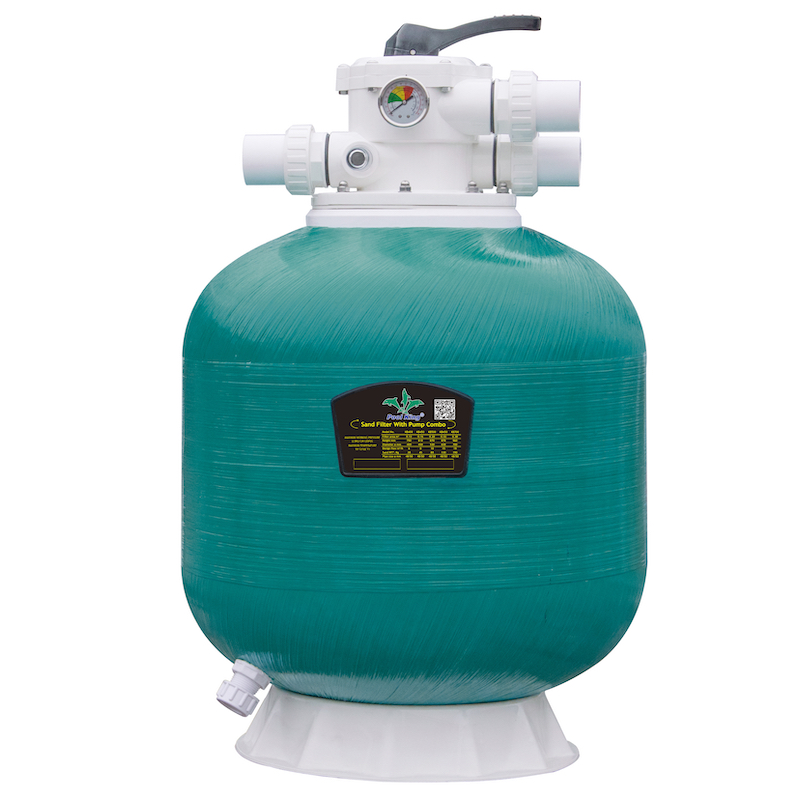
Most 16 inch pool filter models require about 100 lb of #20 silica pool filter sand. Some deeper or higher‑capacity designs may specify up to 110–120 lb, so always check the label or manual for the exact number for your specific unit.
No. Reducing the sand level to “help” a small pump is not a good idea. A shallow media bed dramatically reduces filtration quality and can cause channeling inside the 16 inch pool filter. If your pump is undersized, it is better to adjust pump run time or upgrade equipment rather than underfill the filter.
Many zeolite and glass products are designed so that about 50–60 lb of media is equivalent to 100 lb of silica sand in a 16 inch pool filter. However, density and recommendations vary by brand, so always follow the specific instructions printed on the media bag or technical sheet.
Silica sand generally needs replacement every 5–7 years, depending on how heavily the pool is used and how well the water is balanced. If you notice that backwashing does not restore normal pressure, or the water remains cloudy despite proper chemical treatment, it may be time to replace the sand or alternative media.
In most cases, no. Mixing different media types (for example, half silica and half zeolite) can lead to uneven layering because of different densities, which hurts performance and may cause channeling. For best results, completely remove the old media and fill the 16 inch pool filter with one approved media type at its recommended weight.
1. https://dgpoolsupplyandservice.com/blog/how-much-sand-to-put-in-the-filter/
2. https://www.thepoolfactory.com/blogs/equipment/how-much-sand-to-use-with-your-sand-filter-system
3. https://www.backyardcitypools.com/Filter-Sand-Requirements.htm
4. https://www.poolsuppliescanada.ca/how-much-sand-does-my-pool-filter-need.html
5. https://www.doheny.com/doheny-sand-filter-system-16-in-tank-with-3-4-hp-pump
6. https://www.poolsupplies.com/product/radiant-16-inch-complete-sand-filter-system-110lbs-sand-capacity----frac34--hp-extreme-pump
7. https://lesliespool.com/blog/pool-filter-media-types-a-comparison-guide.html
8. https://springfieldpoolshop.com.au/our-tips/swimming-pool-filters-filter-media-options-sand-vs-zeolite-vs-glass-filter-media/
9. https://intheswim.com/blog/how-much-sand-do-i-need-for-a-sand-filter.html
10. https://intheswim.com/blog/how-to-size-a-pool-filter.html
11. https://www.inyopools.com/HowToPage/how-to-size-a-pool-filter.aspx
12. https://www.inyopools.com/HowToPage/how-to-select-above-ground-pool-filters.aspx


