
Views: 222 Author: Tina Publish Time: 2026-01-02 Origin: Site


Content Menu
● Safety Checks Before You Start
● Tools and Parts You Will Handle
● Step‑by‑Step: How to Take a Coleman Pool Ladder Apart
>> Step 1: Clear and Document the Ladder
>> Step 2: Remove the Ladder from the Pool Wall
>> Step 3: Detach the Base and Rails
>> Step 4: Remove Steps, Treads, and Brackets
>> Step 5: Separate the Top Platform and Handrails
>> Step 6: Handle Model‑Specific Features
>> Step 7: Clean, Inspect, and Store Components
● When You Should Not Take the Ladder Apart
● Related Questions and Answers
>> 1. How long does it take to disassemble a Coleman pool ladder?
>> 2. Do I need special tools to take a Coleman ladder apart?
>> 3. Can I leave a Coleman ladder assembled outside all winter?
>> 4. How often should I inspect a Coleman pool ladder for safety?
>> 5. Are Coleman pool ladders interchangeable with other above‑ground pools?
>> 6. What is the weight capacity of a typical Coleman‑branded ladder?
Coleman above‑ground pool ladders are designed to be assembled and disassembled by adults, mainly for seasonal storage, cleaning, or replacement of damaged parts. Disassembly follows the same logic as assembly, but in reverse order: release clips and fasteners, remove steps and rails, and then separate the platform and safety accessories.[4][5][2][1]
Before touching any hardware, make sure the pool and work area are safe. A few minutes of preparation greatly reduces the risk of slips, pinched fingers, and damage to the ladder or pool wall.[2][6][7][1]
- Turn off any pool pumps and keep swimmers, especially children, away from the ladder area during the entire process.[6][1]
- If you plan to remove the ladder completely, stop pool use and consider partially lowering the water level so you can work more comfortably around the pool edge.[2]
- Wear non‑slip footwear and work on stable ground; avoid standing on wet, slick decks or leaning excessively over the pool wall.[7][1]
- Gather tools such as a crosshead screwdriver, adjustable wrench, and penetrating oil if some bolts have corrosion.[5][1]
- Keep small children from climbing on the ladder while you loosen any part, because one‑person‑at‑a‑time use is a core safety rule even during maintenance.[1][6]
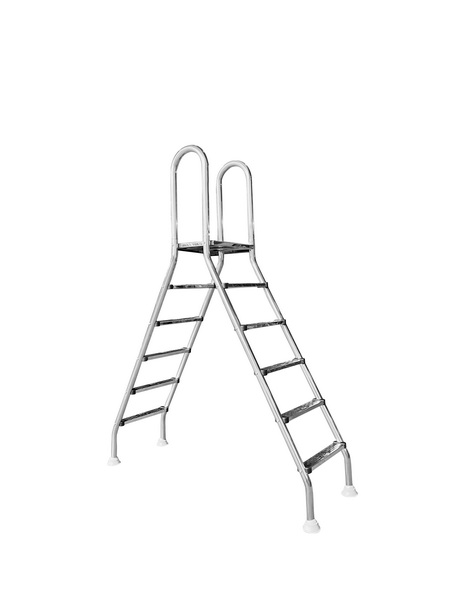
Coleman pool ladders share a common modular, clip‑and‑bolt design, even though exact models vary. Understanding the main components helps you avoid forcing anything during disassembly.[1][2][4]
- Side rails: Curved tubular legs labeled A and B that face in and out of the pool, often joined to a central platform.[8][4]
- Steps or treads: Plastic steps that snap or bolt between rails, sometimes held by retention brackets or pegs.[1][4]
- Top platform: A flat top piece that joins both sides of the ladder and sometimes carries safety graphics or non‑slip texture.[8][4]
- Retention clips and brackets: Plastic or metal pieces that stop steps from sliding out and lock rails into place.[4][1]
- Fasteners: Screws, bolts, nuts and washers sized specifically for above‑ground ladder loads.[5][1]
- Optional accessories: Safety locks, removable outer steps, or pads at the base to protect the pool liner.[6][7]
Good documentation makes later reassembly much faster, especially if you disassemble several ladders for OEM or warehouse operations.[2]
- Remove toys and accessories from the ladder area and clear at least a 1–2 meter working radius around the pool wall and deck.[2]
- Take photos of the ladder installed on the pool from different angles, focusing on how rails connect to the pool frame and how steps are oriented (A side vs B side).[4][2]
- If you have the Coleman or Bestway PDF manual, keep it open to the assembly diagram; you will follow it in reverse as you disassemble.[7][1]
Next, detach the ladder from the pool frame or deck so you can work on it on the ground.[7][2]
- If applicable, unlock or remove any security feature that keeps the ladder from being lifted or tilted away from the pool.[6][7]
- Loosen the screws, nuts, or clamps that hold the ladder to the pool's top rail or deck using a screwdriver and adjustable wrench.[5][1]
- Support the ladder with one hand or a helper while you release hardware so the frame does not twist or stress the pool wall liner.[6][2]
- Carefully lift the ladder away from the pool and place it on a flat, dry surface such as a patio, driveway, or shop floor.[2]
Once the ladder is on the ground, focus on separating the main rails and bases.[2]
- Inspect the base feet where the rails touch the ground and the interior of the pool; some models use removable pads or ballast chambers.[5][2]
- If the feet are weighted or filled with water or sand, drain or empty them before attempting to separate them from the rails to reduce weight.[2]
- Look for screws or locking pins at the joints between vertical legs and base feet; loosen or pull these fasteners out first.[5][1]
- For modular rails, identify snap‑fit joints or plastic clips and gently pry them with a flat tool if needed, but do not force them to avoid cracking plastic.[2]
Steps often carry most of the user's weight and are typically secured with brackets and clips that must be released in a certain order.[1][4]
- Examine each step to locate the retention brackets on the inside of the rails; these often slide or snap into place over molded pins.[1][4]
- Start from the bottom step: press or slide the retention clips as specified in the original assembly instructions, then rotate the step slightly and pull it free from rail A and rail B.[4][2]
- Continue upward, removing each step one by one while keeping them in sequence so you can see any dimensional differences later.[2]
- Place brackets, clips, and fasteners into labeled containers or bags such as “Step 1 hardware,” “Step 2 hardware,” to streamline reassembly or OEM packaging.[2]
The top platform ties both sides together and usually comes off after most steps are removed.[4]
- Locate the bolts or screws that pass through the top of each rail into the underside of the platform; these may be partially hidden by trim caps.[1][4]
- Using your wrench and screwdriver, remove these fasteners while supporting the platform with one hand to prevent sudden drops.[5][1]
- Lift the platform straight up and off the rails, checking for any clips that need to be squeezed or released.[4]
- If your ladder has curved grab handles that attach to the platform, remove their bolts or pins and set the handles aside as separate components.[8][4]
Some Coleman and Bestway branded ladders (often supplied together) integrate additional safety and handling features.[6][1]
- Certain models include removable or lockable outer steps so the ladder cannot be used when the pool is unsupervised; remove locks or hinges and store them together.[7][6]
- If there are foam grips or rubber gaskets on the rails, slide them off carefully and keep them flat so they do not deform in storage.[2]
- Wall‑bracket ladders or deck‑mounted versions may hide fasteners under plastic caps; gently pry caps off to expose screws before removing.[11][2]
Once the ladder is fully disassembled, it is a good time to extend its service life through cleaning and inspection.[2]
- Rinse rails, platform, and steps with fresh water to remove chlorine, salt, and debris, then gently scrub any algae or sunscreen buildup from treads.[2]
- Check for cracked steps, bent rails, corroded bolts, or worn threads and plan to replace any part that no longer meets safety standards.[7][2]
- Dry all components completely and store them in a dry, temperature‑controlled space to minimize corrosion and UV degradation.[2]
- Group parts by function (rails, steps, hardware, accessories) and label boxes or bags clearly for easy identification during the next season or during OEM shipment.[2]
There are situations where full disassembly is not recommended, either for safety or warranty reasons.[5][6]
- If the ladder is structurally compromised (heavily cracked, severely rusted, or bent), do not trust it for future use; retire or replace it instead of trying to restore it.[7][2]
- When a manual specifically warns that certain joints are permanent or not user‑serviceable, leave those parts alone and only remove authorized components.[5][1]
- If disassembly requires cutting, drilling, or heating parts to remove them, consider contacting the manufacturer or purchasing a replacement ladder to avoid damaging the pool or voiding guarantees.[6][1]
A Coleman pool ladder can absolutely be taken apart, provided an adult follows correct safety procedures and the reverse order of the original assembly. By preparing the work area, carefully releasing fasteners and clips, separating steps, platform, and rails, and then cleaning and storing parts correctly, the ladder can be safely reused season after season or integrated into OEM service workflows.[8][1][4][2]
For a typical residential ladder, expect about 20–40 minutes, depending on corrosion level and your familiarity with the clips and bolts.[3][2]
Most models only require a crosshead screwdriver and an adjustable wrench, plus optional penetrating oil for stubborn bolts.[1][5]
Manufacturers recommend removing or securing the ladder and storing it dry; long‑term exposure to sun, ice, and standing water accelerates plastic and metal fatigue.[6][1]
Check steps, rails, clips, and all screws before each swimming season and periodically during heavy use for rust, cracks, or looseness.[7][1]
Many ladders fit multiple steel‑frame or soft‑sided pools with similar wall heights, but always confirm height, weight rating, and mounting method in the owner's manual.[14][5]
A commonly reported rating is several hundred pounds, but exact limits vary by model; always consult the manual or product label for the specific capacity.[15][1]
[1](https://bestwayusa.com/media/pdf_files/Coleman_Pool_Ladder_90392E_2024.pdf)
[2](https://www.poolkingfilter.com/how-to-disassemble-above-ground-pool-ladder.html)
[3](https://www.youtube.com/watch?v=C_FF_-RtEcg)
[4](https://www.youtube.com/watch?v=HMZp6vdZ1nI)
[5](https://www.intexsales.com/b2cmnl/B2CMNLServlet?instantiate=B2cMnldownloadApp&action=pub_mnl&filnam=330IO_A0_1805_EN.pdf)
[6](https://bestwayusa.com/media/pdf_files/Coleman_Power_Steel_Round_Pool_2024.pdf)
[7](https://manuals.plus/m/f55b1fab9bf9be03cd05fab9c917baa027f4f80d3b1910b11282d7e1d9a20871)
[8](https://www.poolkingfilter.com/how-to-put-coleman-pool-ladder-together.html)
[9](https://www.youtube.com/watch?v=JJkG7vsan1E)
[10](https://www.youtube.com/watch?v=ham2QiY9M7M)
[11](https://images.thdstatic.com/catalog/pdfImages/18/18ef8250-9b9a-46b4-8c0d-8d7853dc9aca.pdf)
[12](https://www.tiktok.com/discover/how-to-disassemble-pool-ladder)
[13](https://www.poolkingfilter.com/how-to-set-up-a-coleman-pool-ladder.html)
[14](https://bestwayusa.com/bestway-above-ground-pool-ladder-48-58336e)
[15](https://www.facebook.com/groups/637529959937311/posts/2576536166036671/)
[16](https://content.syndigo.com/asset/77256caf-03f0-4ffd-af3d-250998e24d3f/original.pdf)
[17](https://www.tiktok.com/discover/disassemble-coleman-pool-ladder)
[18](https://www.facebook.com/groups/637529959937311/posts/1948167995540161/)
[19](https://www.facebook.com/groups/637529959937311/posts/2656993104657643/)
[20](https://www.facebook.com/groups/637529959937311/posts/2692859141071039/)


