
Views: 222 Author: Tina Publish Time: 2025-12-08 Origin: Site


Content Menu
● What a Coleman pool ladder includes
● Safety and preparation before assembly
● Step‑by‑step ladder assembly
>> Sorting and matching “A” and “B” components
>> Building the first side of the ladder
>> Assembling the second side and top section
>> Adding handrails and safety clips
● Positioning the ladder on your Coleman pool
● Checking stability, safety, and comfort
● Extra tips to make a Coleman ladder safer and more durable
● When to remove and store your ladder
● OEM ladder and pool equipment solutions for brands and wholesalers
● FAQs About Setting Up a Coleman Pool Ladder
>> 1. Do all Coleman pool ladders assemble the same way?
>> 2. Why are my ladder steps loose after assembly?
>> 3. How can I keep my Coleman ladder from wobbling?
>> 4. Is it safe to leave the ladder in the pool all the time?
>> 5. What maintenance does a Coleman pool ladder need?
>> 6. Can OEM pool ladders be customized for my brand?
A standard Coleman above ground pool ladder normally comes with two sets of side rails, several plastic steps, a top platform or top bars, curved handrails, and a small hardware pack of bolts, nuts, and plastic retention clips. Many models mark the rails and steps with “A” and “B” labels so you cannot mix left and right sides during assembly.[2][4][5][1]
Most ladders are made from a galvanized or painted steel frame combined with high‑impact plastic treads designed for use with 42–52 inch wall height above ground pools. Some Coleman sets include a removable outside ladder section or child‑safety feature that lets adults block access when the pool is not in use.[5][3][2]
Before starting, read the printed safety sheet and confirm the ladder is designed for your pool wall height and weight capacity. Place all parts on a flat surface away from the pool edge so small hardware cannot roll into the water, and keep screws and clips out of children's reach.[3][2]
Use a crosshead screwdriver and adjustable wrench as recommended in the Coleman/Bestway instructions so you can properly tighten all bolts and avoid sharp, protruding edges. Check that the planned ladder location beside the pool is firm, level ground or a stable deck, because a soft or uneven base can make even a well‑assembled ladder feel unsafe.[2][3]
Many Coleman ladders use “A” and “B” markings on both the steps and the side rails, and assembly starts by pairing each A‑side step with an A rail and each B‑side step with a B rail. If you swap sides, the steps may not lock correctly into the legs, so double‑check labels before pressing any tread fully into place.[4][1][5]
Lay out two rails marked A and two rails marked B, then stack the matching steps in the order they will be installed, from bottom tread to top tread. Keep the hardware grouped by length (for example M6×43 bolts separate from longer bolts) to avoid using the wrong bolt in a critical position.[6][1][4][2]
Start by sliding the lower step onto the A and B rails, following the direction arrows printed on the plastic so the non‑slip surface faces upward and any text faces outward. Push the step down until the locking notches are fully seated in the rail cutouts; a few taps with a rubber mallet can help if the fit is tight.[1][4][6]
Continue installing the remaining steps one by one, keeping them evenly spaced according to the illustration in your model's manual. When all treads are in position, check that every step sits flat and does not rock, because a step that is not fully seated may loosen during use.[5][3][1][2]
Repeat the same process with the second pair of A and B rails to build the other side of the ladder, again confirming each step locks firmly into place. With both step assemblies completed, attach the top bars or platform to just one side first, using the correct bolts but leaving them slightly loose so you can adjust alignment.[4][5]
Then slide the second step assembly into the top bar or platform sockets, ensuring any warning labels face outward and the curved legs point away from the pool. Once all joints are aligned, tighten the top hardware securely so the two sides form a rigid frame with no visible gaps at the connections.[6][2][4][5]
Install the curved handles or handrails by pushing them into the open tube ends at the top of the ladder or platform, then secure them using the specified bolts and nuts. Handrails should feel solid under moderate force because they are critical for children and older users when entering or exiting the pool.[3][4][6]
Next, insert plastic retention brackets or safety clips where the steps meet the rails, aligning arrows or tabs with the matching symbols on the ladder frame. These clips help lock the treads in place and must be fully snapped in so they cannot be kicked out accidentally during use.[2][4][5][3]
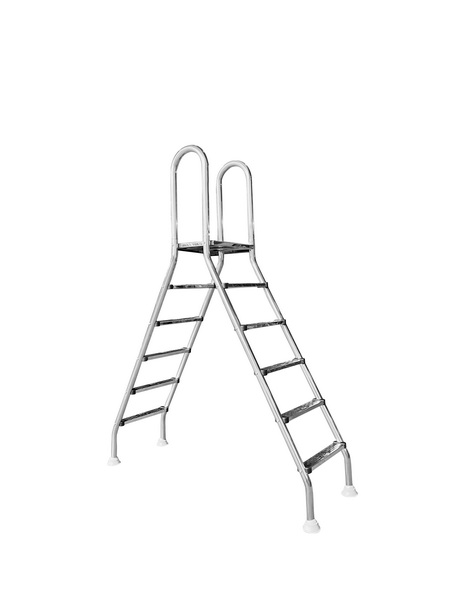
With the ladder fully assembled, carry it to the pool and place it where swimmers will enter and exit most often, keeping clear of skimmers, return jets, and hoses. Above ground A‑frame ladders should stand on level ground on both sides of the pool wall, with the top platform resting squarely on the top rail without twisting the frame.[7][5][2]
The ladder must sit on a solid base such as compacted soil, pavers, or a concrete pad; avoid soft grass or loose sand that might settle and cause rocking. If your Coleman pool is part of a more permanent installation with a deck, follow the manufacturer's direction if any deck‑mount brackets are included or recommended.[3][2]
Once positioned, carefully climb the ladder while another adult observes movement at the base and the top rail; the ladder should not shift, sink, or twist noticeably. Check every step for flex and listen for creaks that may indicate loose hardware or a tread that is not fully seated in the rail.[1][6][2][3]
Tighten all screws and nuts again after this test, making sure there are no sharp edges or protruding bolts that could scratch bare skin. Consider adding a non‑slip mat or small pad under the outside feet to increase friction and protect delicate surfaces such as decks.[8][2][3]
Pool ladder incidents account for a significant number of pool‑equipment related injuries each year, so keeping the ladder safe is as important as maintaining the water. One common upgrade is to choose a ladder that meets or exceeds voluntary safety standards, including handrails on both sides, non‑slip treads, and step width of at least a few inches.[3]
You can also make the ladder more secure by adding simple accessories such as anti‑slip step covers, ladder weights, or straps that connect the frame to your pool's top rail or deck, where appropriate. In high‑use family pools, regularly inspecting clips and treads for cracks and replacing any worn parts helps prevent failures during the swimming season.[9][10][8][3]
The manufacturer recommends removing and securing the ladder when the pool is not supervised to help prevent unsupervised children from entering the water. On many Coleman models, the outside portion can be lifted or removed, or the entire ladder can be taken out and stored in a locked area.[2][3]
At the end of the swimming season, wash the ladder with fresh water, inspect for rust or UV damage, and dry it before storing indoors or in a sheltered shed. Off‑season storage extends the life of metal parts and reduces fading or brittleness in plastic steps, which is especially important for commercial or long‑term OEM installations.[2][3]
In addition to standard Coleman‑style above ground pool ladders, professional pool equipment manufacturers in China can supply OEM pool ladders, sand filters, DE filters, cartridge filters, water pumps, LED lights, and other accessories for international brands and distributors. By combining filtration, circulation, lighting, and safe access systems in one supply chain, overseas partners can build complete above ground pool packages under their own labels.
OEM services typically cover custom colors, private logo printing, packaging design, and technical documentation adapted to local safety regulations, helping importers position their pool products competitively in different markets. For buyers planning new pool sets or upgrading existing kits, choosing an OEM partner that already produces high‑end sand filters, ladders, and lights ensures consistent quality across the whole system.
Setting up a Coleman pool ladder the right way starts with matching “A” and “B” parts, pressing each step fully into place, tightening all hardware, and checking that the assembled frame sits on a solid, level base. Adding stability pads, following ladder safety standards, and removing or securing the ladder when the pool is unattended all help protect families and prolong ladder life.[1][3][2]
For brands, wholesalers, and pool manufacturers, partnering with a professional OEM factory that supplies ladders, sand filters, pumps, and LED lights makes it easier to deliver safe, complete above ground pool solutions to end users worldwide.
Most Coleman and similar above ground pool ladders use the same basic approach of matching A and B rails to labeled steps, but details such as bolt length, number of treads, and platform design vary by model and wall height. Always follow the exact instruction sheet for your ladder's item number instead of assuming a generic video or guide fully applies.[9][4][5][1][2]
Steps often feel loose when they are not fully seated into the rail sockets, when retention clips are not completely snapped in, or when the wrong hardware is used at a connection. Remove the affected step, check the labels and orientation, and reinstall it with firm pressure or a rubber mallet, then confirm all clips and bolts are tight.[6][9][1]
Wobble usually comes from an uneven base under the feet, a soft surface that sinks under load, or slightly loose top connections. Level the ground or add a firm pad, retighten all top bolts, and consider using straps or braces to connect the ladder to the pool rail or deck where suitable.[10][8][3][2]
Leaving the ladder in the pool full‑time increases exposure to water and chemicals, which can accelerate corrosion and plastic aging, and may allow unsupervised children to access the pool. Many safety guidelines recommend removing or locking the ladder when the pool is not under active supervision and storing it indoors over winter.[3][2]
Regular maintenance includes rinsing off chemicals, checking all screws and clips for rust or damage, inspecting treads for cracks, and verifying that the ladder still feels stable on its base. Replace any worn parts promptly and refresh protective coatings on metal surfaces if recommended by the manufacturer to keep the ladder safe throughout the season.[9][2][3]
Yes, OEM ladder manufacturers can usually customize ladder color, branding, packaging, and sometimes step or rail design to meet your brand positioning and regional standards. International buyers often combine custom ladders with OEM sand filters, pumps, and LED lights to create complete private‑label above ground pool sets for retail or project sales.
[1](https://www.youtube.com/watch?v=JJkG7vsan1E)
[2](https://bestwayusa.com/media/pdf_files/Coleman_Pool_Ladder_90392E_2024.pdf)
[3](https://www.poolfencediy.com/blogs/blog/pool-ladder-safety)
[4](https://www.youtube.com/watch?v=HMZp6vdZ1nI)
[5](https://www.youtube.com/watch?v=1OWK8pF9y14)
[6](https://www.youtube.com/watch?v=ham2QiY9M7M)
[7](https://m.bestwaycorp.ca/Product/Item?id=1013382XXX25)
[8](https://www.facebook.com/groups/637529959937311/posts/2579369582419996/)
[9](https://www.poolkingfilter.com/how-to-put-coleman-pool-ladder-together.html)
[10](https://www.facebook.com/groups/637529959937311/posts/2297310227292601/)
[11](https://www.tiktok.com/discover/set-up-coleman-pool-ladder)
[12](https://www.facebook.com/groups/637529959937311/posts/1390488964641403/)
[13](https://www.reddit.com/r/pools/comments/1l7chew/just_bought_this_coleman_above_ground_pool_tips/)
[14](https://www.facebook.com/groups/637529959937311/posts/2181301312226827/)


