
Views: 222 Author: Tina Publish Time: 2026-01-02 Origin: Site


Content Menu
● What Composite Decking Is Designed For
● Safety and Code Considerations for Pool Ladders
● Pros and Cons of Composite Decking for Ladder Use
● Materials Commonly Used for Pool Ladders
● Practical Ways to Use Composite Decking Around a Pool Ladder
● Why a Fully DIY Composite Decking Ladder Is Risky
● A Better Approach: Pair Composite Decking With a Certified Ladder
● OEM Pool Equipment and Custom Solutions (For Brands and Wholesalers)
● Step‑by‑Step: If You Still Want Composite Elements on a Pool Ladder System
● FAQs About Building Pool Ladders From Composite Decking
>> 1. Is composite decking strong enough to use as a pool ladder?
>> 2. Can I at least use composite boards as steps on my pool ladder?
>> 3. What is the safest material for a pool ladder?
>> 4. Will using composite decking for a ladder affect my pool warranty or insurance?
>> 5. How can I match my ladder to my composite pool deck?
>> 6. Can an OEM supplier build custom ladders that integrate with composite decking?
Using composite decking to build a pool ladder is technically possible, but it is usually not recommended as the main load‑bearing structure because composite boards are designed for horizontal decking and stairs, not for narrow, vertical ladder rails constantly exposed to water and chemicals. For most pool owners, the safer option is to use a certified stainless steel or resin pool ladder and, if desired, integrate composite boards only for steps or surrounding platforms.[1][2][3][4]
Composite decking is an engineered material made from wood fibers and plastic, optimized for decks, steps, and platforms rather than for narrow ladder side rails. It excels as a low‑maintenance, splinter‑free walking surface but must be properly supported by joists or stringers underneath to prevent sagging.[5][6][3][1]
- Composite boards typically require closer support spacing (often 9–16 inches on center) than traditional wood to carry body weight safely, especially on stairs.[3][1]
- Manufacturers design their boards assuming they will be fastened flat over structural framing, not loaded in bending as long, unsupported ladder rails or thin rungs.[7][5]
Pool ladders are safety‑critical components that must meet local pool and building codes, including requirements for corrosion resistance, non‑slip treads, secure handholds, and rigid installation. Many codes and guidelines assume ladders will be factory‑tested assemblies in metals or engineered plastics designed for constant immersion and chemical exposure.[8][9][10]
- Public and many private pool rules require pool ladders to be corrosion‑resistant, non‑slip, and rigidly anchored, with handrails extending above the deck edge.[10][8]
- Riser height, tread depth, and clearance from the pool wall are often specified (for example, steps must be non‑slip, with minimum tread depths and maximum riser heights).[8]
Composite decking has some appealing properties for wet environments, but there are trade‑offs when using it directly as a pool ladder rather than as decking or steps next to the pool.[6][2]
- Advantages:
- Resistant to rot, insects, and splinters, making it comfortable for bare feet and poolside traffic.[6][1]
- Many products offer textured, slip‑resistant surfaces that perform well on steps and landings when installed correctly.[11][6]
- Limitations:
- Composite boards rely on underlying structural framing and are not intended to act as standalone structural ladder rails or thin cantilevered rungs.[3][1]
- Constant immersion, pool chemicals, and UV may accelerate aging if boards are used below waterline in ways not covered by manufacturer warranties.[4][2]
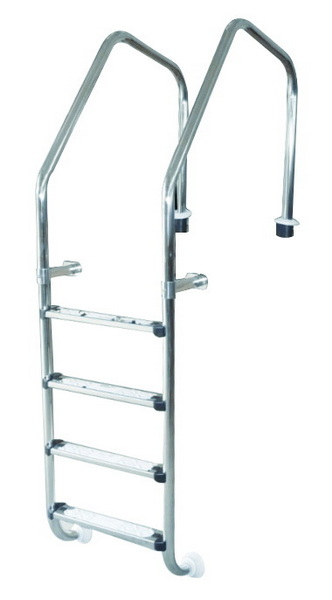
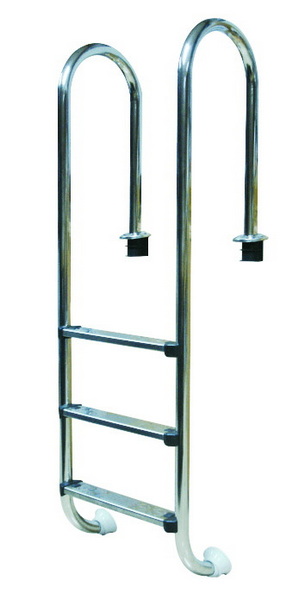
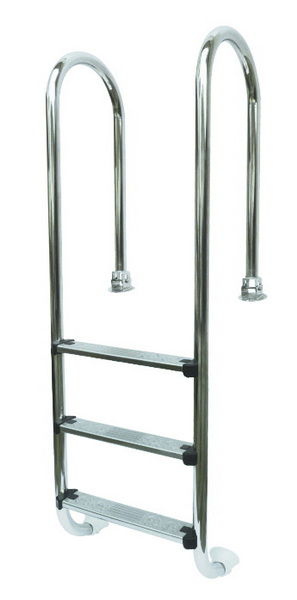
Commercially manufactured pool ladders are most commonly made from stainless steel tubing, reinforced resin, or heavy‑duty plastic, sometimes combining materials to balance strength and corrosion resistance. These materials and designs undergo load testing and are specifically engineered for safe entry and exit in chlorinated or saltwater pools.[12][2]
| Ladder Material | Main Strengths | Key Weaknesses | Typical Use |
|---|---|---|---|
| Stainless steel (304/316) | Very strong, excellent corrosion resistance (especially 316), long service life | Can heat up in sun, higher cost, may stain if not maintained | In‑ground and commercial pools, premium residential laddersmedleypool+1 |
| Resin / composite body | Corrosion‑proof, UV‑resistant, comfortable to touch, lighter than steel | Lower long‑term structural strength than stainless, can chalk or fade | Above‑ground pools, integrated steps, budget‑to‑midrange laddersmedleypool+1 |
| Plastic | Low cost, lightweight | Least durable, can become brittle and deform over time | Small above‑ground pools and temporary laddersmedleypool |
| Mixed (steel + resin) | Combines strong steel rails with resin steps and covers for comfort | Slightly more complex design, mid‑to‑high price | Versatile options for both in‑ground and above‑ground poolsmedleypool+1 |
While composite decking is not ideal as the primary structural ladder frame, it can be safely and attractively integrated around a pool access system when paired with a certified ladder. This approach combines the aesthetics of composite boards with the proven strength of purpose‑built ladder assemblies.[14][6][1][2]
- Build composite deck stairs or platforms up to pool height, following manufacturer requirements for stringer spacing, fasteners, and tread dimensions, then mount a stainless or resin pool ladder at the waterline.[5][1]
- Use composite boards for treads and risers on wide walk‑in steps or “wedding cake” style entries built over a structural frame, while still relying on metal handrails and brackets that meet pool safety codes.[13][6]
Constructing a full pool ladder from composite deck boards and improvised hardware introduces several structural and safety risks that can be difficult to control without engineering and load testing.[1][8]
- Composite boards may flex excessively when used as narrow ladder rungs or rails, especially with the dynamic loads of jumping, bouncing, or multiple users.[3][1]
- Improvised designs may lack proper handholds, anti‑slip surfaces, clearances, and corrosion‑resistant fasteners, making it harder to comply with pool codes and insurance requirements.[8][10]
For most homeowners, the safest and most cost‑effective solution is to combine composite decking around the pool with a factory‑made pool ladder or step system designed for that specific pool type. This hybrid approach still gives a stylish, low‑maintenance look while maximizing safety and regulatory compliance.[12][6][14][2]
- Install a wrap‑around composite deck with stairs and guardrails at the pool perimeter, then attach a certified in‑ground or above‑ground ladder through pre‑designed anchor sockets or mounting plates.[15][14]
- Choose ladder models that specify compatible pool wall heights, deck thickness, and anchoring hardware, so the system works correctly with your composite structure.[15][12]
Brands, wholesalers, and pool equipment manufacturers who want coordinated decking and access solutions can partner with OEM factories that produce pool ladders, steps, and filtration equipment under private label. This allows them to offer matched sets of composite‑compatible ladders, filters, pumps, and LED lights packaged for specific pool systems.[4][12]
- OEM suppliers can design ladder and step systems that integrate with composite decks while still using stainless steel or engineered resins where structural performance is critical.[12][2]
- The same OEM partners often provide sand, DE, and cartridge filters, pumps, and pool lighting, creating consistent performance and appearance across the entire pool equipment line.[12]
If local codes and manufacturer guidelines allow, composite decking can be used for certain non‑critical parts of a pool access system, such as step treads above the waterline mounted over a structural frame. Always confirm with the decking manufacturer and pool safety regulations before attempting any custom design.[1][8][3][10]
1. Check local codes and permits
- Verify pool ladder and step requirements, including tread dimensions, riser heights, handrail rules, and material expectations.[14][8]
- Confirm whether custom ladders are allowed or if certified assemblies are mandatory in your area.[9][10]
2. Consult the composite decking manufacturer
- Review technical documents for structural limits, allowed applications, and warranty conditions around pool use.[6][3]
- Ask directly whether using boards as step overlays or risers in a pool environment is permitted and under what support conditions.[5][3]
3. Design a structural frame in appropriate materials
- Use pressure‑treated lumber, stainless steel, or engineered metal framing for the load‑bearing structure, sized and spaced according to decking and building code requirements.[5][1]
- Provide sufficient stringer spacing (often closer for composite than for wood) to minimize deflection under pool traffic loads.[7][1]
4. Add composite boards only as surfaces
- Fasten composite boards to the supporting frame with manufacturer‑approved screws or clips, maintaining expansion gaps and drainage.[6][5]
- Use textured boards for non‑slip surfaces and consider nosing pieces or fascia to protect edges.[11][6]
5. Attach a certified pool ladder or handrail system
- Install stainless or resin ladder rails that meet pool safety requirements, anchoring through the composite surface into the structural frame or anchor cups.[15][2]
- Verify ladder stability and rigidity by load testing before regular use.[8][10]
A pool ladder built entirely out of composite decking boards is generally not the safest option, because composite planks are intended as surface materials over structural framing, not as standalone load‑bearing ladder rails or rungs. The better strategy is to use composite decking for the surrounding deck and possibly for step surfaces, while relying on a certified stainless steel or resin pool ladder that meets pool codes and has been structurally tested. By combining these elements—and by working with experienced OEM pool equipment suppliers when designing integrated systems—pool owners and brands can achieve a stylish, low‑maintenance, and code‑compliant access solution around the pool.[2][3][14][12][1]
Composite decking is strong when properly supported as a horizontal surface, but it is not engineered to act as long, unsupported ladder rails or narrow rungs, so using it alone as a pool ladder is not recommended.[3][1]
Composite boards can sometimes be used as treads over a structural frame above the waterline, provided the manufacturer allows this application and local codes are met, but the main ladder structure should still be a certified design.[6][8]
High‑quality stainless steel (especially 304 or 316 grades) is widely considered the safest and most durable ladder material for outdoor pools, with reinforced resin and composite ladders also popular in above‑ground and budget‑friendly setups.[2][12]
Non‑standard, DIY pool ladder designs made from decking materials may not meet code and could create issues with warranties or insurance coverage in the event of an accident, so many experts advise using certified ladders only.[10][8]
The most reliable solution is to build a composite pool deck and steps around the pool and then select a stainless or resin ladder that coordinates in color and style while anchoring securely through the composite boards into the structural framing.[14][15]
Yes, many OEM pool equipment factories can design and manufacture private‑label stainless or resin ladders and step systems that are optimized to work with composite decks while maintaining structural strength and compliance.[12]
[1](https://salcorplandscaping.com/composite-deck-stairs/)
[2](https://medleypool.com/blog-details/best-materials-for-swimming-pool-ladders-pros-and-cons-of-stainless-steel-resin-and-plastic)
[3](https://www.decks-docks.com/proper-joist-spacing-for-composite-decking)
[4](https://insights.made-in-china.com/Why-Do-Swimming-Pool-Ladders-Matter-More-Than-You-Think-The-Surprising-Truth-Behind-Pool-Safety-and-Comfort_QAlTOwqFnJHX.html)
[5](https://www.lowes.com/n/how-to/build-a-deck-composite-stairs-and-stair-railings)
[6](https://neotimber.com/decking/advice/installation/design-considerations/steps/)
[7](https://www.facebook.com/groups/745270033403382/posts/1141007753829606/)
[8](https://codelibrary.amlegal.com/codes/sunsetcityut/latest/sunsetcity_ut/0-0-0-4206)
[9](https://www.floridahealth.gov/environmental-health/swimming-pools/_documents/64e-9_fac_draft_rev7_no_strike.pdf)
[10](https://codes.iccsafe.org/content/FLRC2020P1/chapter-45-private-swimming-pools)
[11](https://www.ringsend.com/blog/post/design-ideas-for-composite-deck-stairs)
[12](https://www.svadonpoolcn.com/best-pool-ladder-in-ground-features-safety-installation-guide/)
[13](https://blog.grepool.com/en/articles/safety/what-type-of-ladder-to-choose-for-an-above-ground-pool/)
[14](https://www.thisoldhouse.com/pools/tips-for-building-a-deck-around-your-above-ground-pool)
[15](https://www.steinbach-group.com/en/pool-accessories/pool-ladder/)
[16](https://ryanhobbies.com/deck-stairs-that-look-awesome/)
[17](https://www.reddit.com/r/Carpentry/comments/1fegwaw/stringer_overload_helping_neighbor_with_his_deck/)
[18](https://www.youtube.com/watch?v=vV97juhgJ3E)
[19](https://lee.floridahealth.gov/programs-and-services/environmental-health/pools-and-spas/_documents/fbc%20424_1%20pools.pdf)
[20](https://www.youtube.com/watch?v=Jl1xm_HUogE)


